We are coming up on the 11th anniversary of the terrorist attacks of 9/11, and the annual appraisal of where we are as a nation as a result. Better or worse? Safer or less safe?
Here is Sasha Baron Cohen's take on the subject. He is much like Michael Moore--more likely to use a sledgehammer than a light hand when making a point, even when the later would yield better results. It is not results they are after--it is the message, pure and simple. So it is with brute force that they say what they mean.
And make no mistake. Sasha Baron Cohen's movie 'The Dictator' is not a good movie.
But does he make a good point?
His character goes on a diatribe that is markedly out of place in terms of a comedy (even a dark one), and lacks the comedic timing of 'The Daily Show's sharp tongued well aimed barbs. Here it is. See what you think.
"Why are you guys so anti-dictator?
Imagine if America was a dictatorship. You could let 1 percent of the people have all the nation’s wealth. You could help your rich friends get richer by cutting their taxes and bailing them out when they gamble and lose. You could ignore the needs of the poor for health care and education. Your media would appear free, but would secretly be controlled by one person and his family. You could wiretap phones. You could torture foreign prisoners. You could have rigged elections. You could lie about why you go to war. You could fill your prisons with one particular racial group, and no one would complain. You could use the media to scare the people into supporting policies that are against their interests."
Monday, September 10, 2012
Sunday, September 9, 2012
A Pig, A Barn, A Party
Last night was our fifth annual barn party, held at the Secrest Octagonal Barn in West Liberty. The barn itself is a gorgeous piece of architecture to behold. It soars 75 feet above the third floor of the barn and while it was built to store hay (and has an ingenious system for delivering hay to the level where the animals lived), the magnificence of it was clearly to demonstrate the wealth of the owner and the skill of the builder.
I do think that a great place is a very good first ingredient in an enjoyable event. But it is never enough. The right mix of people and entertainment makes for a memorable time. This party is hosted by 8 people, and we each invite people from all parts of our lives--our friends, our neighbors, and our co-workers. People we like and would like to spend more time with. That is the very best part of the party.
The second best part is that the music is live, and it is fun, and it is good. And loud. You can stand outside the barn all night and enjoy the music (thankfully there aren't close neighbors to the barn, because I am pretty sure they would be able to hear it as well, and that might not be the best part for them).
Finally, the food is always spectacular. We provide the meat, but from then on it is a pot luck, and I have always eaten well. So join us next year!
Saturday, September 8, 2012
The Secret World of Arrietty (2012)
This movie is based on Mary Norton's celebrated 1952 novel "The Borrowers". Apparently it has been on the mind of Japan's Hayao Miyazaki, the great animator of the modern age, for more than 40 years. He did not direct this version himself, but having planned and written the screenplay and hand-picking director Hiromasa Yonebayashi, Miyazaki and his elevating, protective spirit hover over this production like a most benevolent deity. And Miyazaki is a hero of mine. The world that he animates is lush with birds and bugs and plants and sounds. So the Borrowers go Japanese in this version of the story.
I loved this movie (with the exception of Arrietty's mother, who loses her individual appeal by he frequent shrieking, which is annoying and doesn't add to the overall story, or help us sympathize with their plight). The story is that Arrietty and her family are 'little people'--very little people, who would fit nicely in a doll house. They live under the floors and in the walls of people's houses, and 'borrow' what they need for their subsistence. They do not under any circumstances interact with humans. The house that Arrietty and her parents live under inhabited by Haru, a housekeeper who is not well dispossed to them (she has apparently been blames for some of the disappearances) and Shawn, who is a young boy anticipating an operation for his heart that he is unclear about his chances of surviving. The Borrowers are the closest thing he has to a friend, and while he makes a few missteps, he is on their side. This is in the arena of 'Kiki's Delivery Service' in terms of quality, and I found it peaceful and enjoyable.
Friday, September 7, 2012
The Unlikely Pilgrimage of Harold Fry by Rachel Joyce
This book opens the 2012 Man Booker Prize nominee reading season--which lasts for quite some time, because I still have one book from the 2011 season yet to read, but the very most exciting time to begin is right now, when there are 12 possibilities as winners, all equivalent in their ability to take the prize (or even make the short list). One of the challenges is that often at this point, very few of them are available in the United States, and so what I read first is dictated by that--what I can read first, without having to resort to Amazon.UK. In the past I have been able to get some on the Kindle, but that avenue is limited this time around. The good news is that 5 of the 12 are in print in the U.S., and this is the first one I read. Well, it definitely won't win. Not enough gravitas. It is a joy to read. I almost couldn't put the book down. The story is that Harold gets a letter from Queenie, someone he has not heard from in a very long time. She tells him she is dying of cancer. Harold writes a reply that has the same emotional content of her letter to him--it is perfunctory. But en route to the mailbox to post it, he undergoes a transformation that even he does not understand. He decides to walk to Queenie's bedside. Which is about 500 miles away. He has inadequate foot wear, no rain grear, no advanced training, no sunscreen, no map, nothing. The rest of the book is about the people he meets, the past that he is escaping, the things that matter to him (some of which surprise him), the things he learns--about himself and others, and the way the pilgrimage changes him. It is like Queenie's letter has unstopped a dam of pent up emotions in Harold, and he cannot stop them coming. They rain down, one after another, and it is a wonderful thing to behold.
Thursday, September 6, 2012
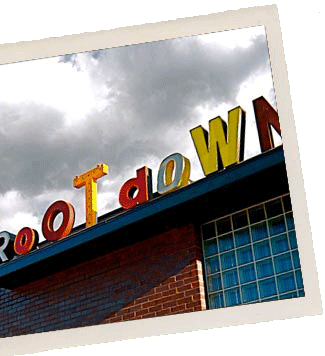
Root Down, Denver
This restaurant was happening the Friday night that I was there recently. The happy hour goes until 7:00pm, with half priced drinks that you can have in the bar or in the restaurant, which might explain why at 6:00pm the place was completely packed. THe drink selection was interesting, and you could order food at the bar, so if you got waylaid there for any length of time you would be contented, and at half price, the drinks were a good deal.
Now for the food. I really liked all of the dishes we got and my dining companion liked three of the four. Her objection, which was completely legit, is that the dish we were served was not the dish that was described to us. we thought we were getting a salad with some sauteed and fried seafood--what we got was some very well fried seafood, no salad. Tasty, but we would have ordered something else had we known.
We started with the red curry carrot soup, which was delicious. I liked that they didn't bat an eye when they said we wanted to share it--they just brought us two spoons. I like a place that facilitates you sharing dishes, and this is a place where you could get a number of small plates and taste a range of what they have to offer.
The mussels we got, with a red curry coconut sauce, did make us smile. Better than we would have expected and my only disappointment was that there really too much of the rich sauce for two of us to mop us with the grilled bread. We really could have used a third mouth to feed.
The duck hoison slider that the best dish of the night in that it was flavorful, interesting, and something that you would not be all that likely to whip up at home. The meat was shredded and the flavor was well distributed throughout without being messy. In retrospect we should have gotten the larger version of the dish, which would have given us a slider each, but that is not what we ordered, and the good news is that the slider bun was both delicious and easy to cut, and then eat a half of. The pickled vegetables that accompanied the dish were inspirational--they literally made me want to go home and make some myself for future sandwiches.
Wednesday, September 5, 2012
Harvesting Grapes for Wine
I recently had my first opportunity to pick grapes--we were visiting a friend of a friend's 6 acre personal hobby vineyard--which sounds like it might be a modest place, but it is not. We harvested almost 1/2 a ton of grapes and only did about an 1/8 of an acre worth of harvesting. So six acres can produce a prodigious amount of wine--certainly more than one could drink between seasons. The vineyards were wonderfully kept--which clearly takes a monumental amount of time, and begs the question of the fine line between a hobby and a job.
I learned two important lessons from my afternoon in the fields. The first is that while I wasn't terrible at harvesting grapes, I wasn't going to make a living doing it. I had comfortable shoes, sunscreen, and large hat, and good equipment, but I definitely was not speedy. I also did not have enough water, which I really should have known better about. The corollary to this lesson is that they are not charging nearly enough for wine. It reminded me of the time I took a basket weaving class at a local museum. We made what has to be the easiest basket design available, and used weaving material that had been gathered and prepared prior to the class--so we did not even procure our raw materials--and yet I came home with a half finished basket and a firm belief that baskets were far too cheap considering the workmanship that goes into them. Such was the lesson I learned when picking wine grapes.
The second lesson that I learned is that wine grapes at harvest taste delicious. We picked Syrah, Gewürztraminer, and Villard Blanc grapes--the Gewürztraminer in particular tasted impossibly sweet and vaguely like the wine that it eventually produces. The experience in the fields made we want to do something that I have never wanted to do before--take a class at UC Davis. It is slightly inconvenient now that I live 2,000 miles away rather than 200, but it would be great fun to learn more about this entire process.
I learned two important lessons from my afternoon in the fields. The first is that while I wasn't terrible at harvesting grapes, I wasn't going to make a living doing it. I had comfortable shoes, sunscreen, and large hat, and good equipment, but I definitely was not speedy. I also did not have enough water, which I really should have known better about. The corollary to this lesson is that they are not charging nearly enough for wine. It reminded me of the time I took a basket weaving class at a local museum. We made what has to be the easiest basket design available, and used weaving material that had been gathered and prepared prior to the class--so we did not even procure our raw materials--and yet I came home with a half finished basket and a firm belief that baskets were far too cheap considering the workmanship that goes into them. Such was the lesson I learned when picking wine grapes.
The second lesson that I learned is that wine grapes at harvest taste delicious. We picked Syrah, Gewürztraminer, and Villard Blanc grapes--the Gewürztraminer in particular tasted impossibly sweet and vaguely like the wine that it eventually produces. The experience in the fields made we want to do something that I have never wanted to do before--take a class at UC Davis. It is slightly inconvenient now that I live 2,000 miles away rather than 200, but it would be great fun to learn more about this entire process.
Tuesday, September 4, 2012
David Copperfield by Charles Dickens
My second son is taking a class in British Literature, and I am reading the books along side of him. I have not had the best reading year of the last decade this year, and of the 12 books they are reading, I have read exactly zero of them, despite the fact that they are all old enough to be off patent (so 70+ years from publication), and available free of charge on the Kindle. It's a sign.
David Copperfield is the book we start off with. I have read a half dozen or more Dickens (can you really count 'A Christmas Carol' as one? If so I might be closer to ten books) and I have owned the complete Dickens oeuvre for two decades, so not a bad place to start the semester--a guy I already know and like. Dickens named this the favorite of all his works and several other heavy hitters agree with him. Henry James remembered hearing it aloud by his mother. Dostoyevsky took it to a Siberian prison camp. Franz Kafka called his first novel an imitation of it. James Joyce paid it reverence through parody in Ulysses. Virginia Woolf, who otherwise betrayed little regard for Dickens, confessed the durability of this one novel, for it belongs, she said, to "the memories and myths of life". The book was also Sigmund Freud's favourite novel. Charlotte Bronte referred to the novel in a letter to William Smith Williams on 13 September 1849, noting that "I have read David Copperfield; it seems to me very good—admirable in some parts. You said it had affinity to Jane Eyre: it has—now and then—only what an advantage has Dickens in his varied knowledge of men and things!".
It is damn good--they are all right about that. It is felt to be the most autobiographical of Dicken's work (although not strictly so), and to my ear, it is the one that has the best outcome for the largest number of characters (although not everyone gets out alive, and there are several very unsavory characters in the mix). Dickens is a great story teller, an author whose novels have a broad sweeping scope and the ability to keep the reader interested over the course of a character's lifetime, which in Dicken's England is bound to have a lot of ups and downs. David is born without a father, his mother is young and niave, which serves neither of them well, and he does acquire an evil step father at an early age. He has a few significant set backs as a child and is left an orphan at a young age, but overall he fares pretty well, and this is among the most uplifting of Dickens tales. Fantastic!
David Copperfield is the book we start off with. I have read a half dozen or more Dickens (can you really count 'A Christmas Carol' as one? If so I might be closer to ten books) and I have owned the complete Dickens oeuvre for two decades, so not a bad place to start the semester--a guy I already know and like. Dickens named this the favorite of all his works and several other heavy hitters agree with him. Henry James remembered hearing it aloud by his mother. Dostoyevsky took it to a Siberian prison camp. Franz Kafka called his first novel an imitation of it. James Joyce paid it reverence through parody in Ulysses. Virginia Woolf, who otherwise betrayed little regard for Dickens, confessed the durability of this one novel, for it belongs, she said, to "the memories and myths of life". The book was also Sigmund Freud's favourite novel. Charlotte Bronte referred to the novel in a letter to William Smith Williams on 13 September 1849, noting that "I have read David Copperfield; it seems to me very good—admirable in some parts. You said it had affinity to Jane Eyre: it has—now and then—only what an advantage has Dickens in his varied knowledge of men and things!".
It is damn good--they are all right about that. It is felt to be the most autobiographical of Dicken's work (although not strictly so), and to my ear, it is the one that has the best outcome for the largest number of characters (although not everyone gets out alive, and there are several very unsavory characters in the mix). Dickens is a great story teller, an author whose novels have a broad sweeping scope and the ability to keep the reader interested over the course of a character's lifetime, which in Dicken's England is bound to have a lot of ups and downs. David is born without a father, his mother is young and niave, which serves neither of them well, and he does acquire an evil step father at an early age. He has a few significant set backs as a child and is left an orphan at a young age, but overall he fares pretty well, and this is among the most uplifting of Dickens tales. Fantastic!
Monday, September 3, 2012
Let America Be America Again by Langston Hughes
Let America be America again. Let it be the dream it used to be. Let it be the pioneer on the plain Seeking a home where he himself is free. (America never was America to me.) Let America be the dream the dreamers dreamed-- Let it be that great strong land of love Where never kings connive nor tyrants scheme That any man be crushed by one above. (It never was America to me.) O, let my land be a land where Liberty Is crowned with no false patriotic wreath, But opportunity is real, and life is free, Equality is in the air we breathe. (There's never been equality for me, Nor freedom in this "homeland of the free.") Say, who are you that mumbles in the dark? And who are you that draws your veil across the stars? I am the poor white, fooled and pushed apart, I am the Negro bearing slavery's scars. I am the red man driven from the land, I am the immigrant clutching the hope I seek-- And finding only the same old stupid plan Of dog eat dog, of mighty crush the weak. I am the young man, full of strength and hope, Tangled in that ancient endless chain Of profit, power, gain, of grab the land! Of grab the gold! Of grab the ways of satisfying need! Of work the men! Of take the pay! Of owning everything for one's own greed! I am the farmer, bondsman to the soil. I am the worker sold to the machine. I am the Negro, servant to you all. I am the people, humble, hungry, mean-- Hungry yet today despite the dream. Beaten yet today--O, Pioneers! I am the man who never got ahead, The poorest worker bartered through the years. Yet I'm the one who dreamt our basic dream In the Old World while still a serf of kings, Who dreamt a dream so strong, so brave, so true, That even yet its mighty daring sings In every brick and stone, in every furrow turned That's made America the land it has become. O, I'm the man who sailed those early seas In search of what I meant to be my home-- For I'm the one who left dark Ireland's shore, And Poland's plain, and England's grassy lea, And torn from Black Africa's strand I came To build a "homeland of the free." The free? Who said the free? Not me? Surely not me? The millions on relief today? The millions shot down when we strike? The millions who have nothing for our pay? For all the dreams we've dreamed And all the songs we've sung And all the hopes we've held And all the flags we've hung, The millions who have nothing for our pay-- Except the dream that's almost dead today. O, let America be America again-- The land that never has been yet-- And yet must be--the land where every man is free. The land that's mine--the poor man's, Indian's, Negro's, ME-- Who made America, Whose sweat and blood, whose faith and pain, Whose hand at the foundry, whose plow in the rain, Must bring back our mighty dream again. Sure, call me any ugly name you choose-- The steel of freedom does not stain. From those who live like leeches on the people's lives, We must take back our land again, America! O, yes, I say it plain, America never was America to me, And yet I swear this oath-- America will be! Out of the rack and ruin of our gangster death, The rape and rot of graft, and stealth, and lies, We, the people, must redeem The land, the mines, the plants, the rivers. The mountains and the endless plain-- All, all the stretch of these great green states-- And make America again!
My youngest son read this poem for a class on understanding American culture,
and I felt that it was right on target for Labor Day.
Sunday, September 2, 2012
Second Home in Denver
I was able to have Sunday brunch at this restaurant in Denver on a recent trip there. The brunch menu is fantastic--with straight ahead breakfast food, a salad and sandwich section, and then some things in between. I saw a plate go by which was piled high with fried chicken--and doughnuts. This place does do 'fry' right. I had a salad and a sandwich, and unbeknownst to me, the sandwich came with fries--which were delicious. The food we had at our table was well prepared, and we all agreed that the menu had numerous items that we would be happy to come back and try. The atmosphere of the restaurant was pleasantly noisy, and there were tables that were outside, enabling them to take advantage of a gorgeous day. The chef here, Jeff Bolton, is competing this weekend in the Cochon BBQ cook off in Memphis. He is cooking a whole heirloom pig in a caja china, and I wish him great luck. The charcuterie plate at Second Home includes some options from La Quercia, in Norwalk, Iowa, so he knows his pork, that is for sure. Good luck to Jeff and I hope to return to Second Home to try some of the food the dinner menu offers.
Saturday, September 1, 2012
The Hunger Games (2012)
The first warning is that this is a long movie, logging in at almost 2 1/2 hours. Unlike many movies that are this length, I did not finish watching it and feel like there were whole swaths of it that could have been cut. On the contrary, I felt the lead in to the 'Hunger Games' of the title was if anything a bit on the short side. I have read this trilogy, so I knew what was going on, but laying out the dystopian society that is the backdrop to the main action in this movie could have been even a bit more thorough.
The second warning is, don't watch it late at night. The second half is a race for survival, and again, I read the book. I knew what would happen before it unfolded on the screen, and yet I found myself completely caught up in the action, and definitely could not have dropped off to sleep afterwards.
The society depicted here is on the one hand very advanced--bullet trains and sleek skyscrapers--and on the other hand very shallow and petty. So we are prone to hate the government right off the bat. It is an extreme classist society--the people in the Capital have all the money and resources, all the food and none of the work. They live off the Districts, who work in a kind of enslaved labor, divided by industry or agriculture. Katniss is a 16 year old girl from District 12, which is a coal mining district, poor and oppressed--think Appalacia, or better yet, her last movie, 'Winter's Bone'. Soul crushing poverty, mixed with a totalitarian regime, and a father who died in a coal mining accident. Much like 'Winter's Bone', the mother is weak, and it is left to the eldest daughter to fend for the family. She is brave, smart, cunning, and she knows how to hunt. The government has a Romanesque tournament every year, where they go to each district and randomly choose a boy and a girl (ages 12-18), is a process called 'The Reaping'. These children are placed in an arena and the whole Capital watches as they kill each other off, one by one, until there is a sole child standing. Katniss volunteers for this barbaric ritual when her sister is chosen, then spends the rest of the movie struggling to stay alive, and grappling with the lose-lose situation that she has plunged herself into. Lots of good material here, and the movie remains more or less faithful to the book as well.
Subscribe to:
Posts (Atom)