Sunday, April 1, 2012
Nut Cake with Orange Salad
Joel made this fantastic cake, a variation on a cake in the A16 cookbook (we are going to have to eat there when we are in San Francisco in May)
1 1/3 cups unsalted pecans
1 1/3 cups blanched whole almonds
1/2 cup plus 2 tablespoons (5 ounces) unsalted butter, at room temperature
3/4 cup plus 3 tablespoons sugar
3 lemons
1/2 teaspoon pure vanilla extract
3 eggs
1/2 cup plus 1 tablespoon "00" flour or all-purpose flour
1/4 teaspoon kosher salt
ORANGE SALAD
3 mandarin oranges
2 Valencia, navel, or blood oranges
1/4 cup orange marmalade
1 teaspoon freshly squeezed lemon juice
1/2 cup vanilla yogurt (I prefer Brown Cow Non-Fat Vanilla Yogurt)
Preparation
To make the cake, preheat the oven to 300°F. Butter a 4-by-8-inch loaf
pan. Then, using a sifter or a fine-mesh strainer, dust it with flour,
tapping out the excess.
In a food process, combine the pistachios and almonds and pulse until
finely ground. Set aside.
Combine the butter and sugar in the bowl of a stand mixer. Grate the
zest from the lemons directly into the bowl. Fit the mixer with the
paddle attachment and beat on medium speed for about 2 minutes, or
until smooth and creamy. Mix in the vanilla just until incorporated.
On low speed, gradually add the nuts and mix just until incorporated.
Then add the eggs, one at a time, mixing after each addition just
until incorporated. Stir in the flour and salt and mix just until
incorporated.
Spoon the batter into the prepared loaf pan. Bake until a skewer
inserted into the middle of the cake comes out clean, about 45
minutes. Let cool in the pan on a wire rack for 10 minutes. Then, run
a paring knife around the inside of the pan to loosen the cake sides,
invert the cake onto a plate, and lift off the pan. At this point, the
cake can be served warm or allowed to cool completely before being
sliced and reheated.
To make the orange salad, cut a slice off the top and bottom of 1
orange, stand the orange upright, and cut downward to remove the rind
and pith in thick strips. Cut the orange crosswise into 1/4-inch-thick
slices, capturing any juice. Repeat with all of the remaining oranges.
Set the oranges slices aside until needed.
Gently heat the marmalade in a pot over low heat for about 3 minutes,
or until syrupy. Add any captured orange juice along with the lemon
juice to the marmalade. Remove the pot from the heat and add 1 to 2
tablespoons water to think the marmalade to the consistency of a
vinaigrette. Let cool.
To serve, preheat the oven to 400°F. Cut the cake into generous slices
and place on a baking sheet. Bake the slices, turning them over once,
for about 5 minutes, or until warm and slightly toasted on both sides.
Place 4 or 5 orange slices on each plate and drizzle generously with
the marmalade syrup. Place the warm pieces of cake next to the orange
slices and top with a dollop of yogurt. Serve immediately.
Saturday, March 31, 2012
Walking on the Dead
The practice of burying people in the church, known as intramural burial, goes back a ways. The churches in Florence harken back to the emergence of Italy from the dark ages--well, she really peaked out in a big way very early, then had a significant set back, which sent Dante packing and left Galileo under house arrest and in isolation from his fellow scientists. So it is not surprising that the practice of burying people in churches persisted into the modern era.
These two graves are in the floor of the Basilica of Santa Croce. There was a time when churches smelled of the dead buried beneath their floors--admittedly, it probably didn't smell that great outside at that time either. Bodies were buried in shallow graves, and if they died within the Christian faith, they were buried near the church. At some point, the problem of contagion from the dead to the living was pointed out--perhaps we shouldn't bury them so close by, and maybe deeper is better than just beneath the surface.
I know, we are walking on graves all the time. We know not what lies below our feet. Whole cities are built upon the resting places of people who died before. The idea of digging up bones and sticking them in big anonymous piles in an ossuary is also a concept I am not settled in with either. But it strikes me as odd that people would want to spend eternity constantly under the feet of others.
Friday, March 30, 2012
Still Walking (2008)
The three generations gather together in this atmospheric, quiet, stirring film from the Japanese director Hirokazu Kore-eda. They fit easily--and yet uneasily--under the same roof. There is enough physical space for them. It is the emotional space that causes tension. Set in a port city, though largely played out in the tight, boxy confines of a single home, the film turns on a melancholic, at times resentful and seethingly angry 15th-anniversary reunion to mark the death of the eldest son. Grief has brought the scattered family members together, and grief is what keeps them apart. The eldest son has been drowned saving a child from the ocean. He was the prodigal son,the pride of the father and the envy of his brother. When he dies, they are not only unable to resolve their grief, they are also unable to resolve their anger and unmet expectations. They cannot move on, and we see the effect that has on both parents, the siblings, and a glimmering of what the next generation might experience related to this loss.
While the bulk of the film occurs over a 24 hour period, there is a flash forward to what the future holds. Which is bittersweet. The message to me was to resolve these problems, otherwise you are embittered for life, maybe even stunted in your ability to enjoy your own life--surely not what the eldest son wanted in his death--and it ripples out from there. Beautifully filmed, well paced, and very thoughtful.
Thursday, March 29, 2012
Chickpea, Potato, and Cabbage Curry
Coming off a wonderful cooperatively cooked Indian dinner for 70, I have been inspired to make more than my usual curried lentils and chana dal. Usually it is my husband who is experimenting with curries, but I am more likely to cook legumes than he is, and so there is a place for me in this paradigm. This is adapted from Madhur Jaffrey' recipe in 'From Curries to Kebabs'
1 cup dried garbanzo beans
1 cup chunked onion
4 garlic cloves
¼-½ teaspoon red pepper flakes
2 tablespoons oil
1 tablespoon hot curry powder
1 teaspoon just cumin powder
1 lb potato , peel and cube
1 -2 teaspoon salt (to taste)
4 ½ cups cabbage , chunks
Directions:
1.
Soak the chickpeas overnight in water to cover. Drain, recover with fresh water and bring to a boil. Reduce heat and simmer covered until very tender. Drain and reserve the cooking liquid. Add enough water to the reserved cooking liquid to equal 2 1/2 cups.
2.
Put the onion, garlic, peppers and 1/4 cup of water in a blender and process until smooth. You can always add more pepper in the end, but you can't take it away.
3.
Heat the oil over a medium high heat. Put in the onion paste and stir fry for 2-3 minutes.
4.
Reduce the heat to medium low, then cover and continue cooking the paste. for another 2-3 minutes. Stir it frequently just to prevent sticking, and keep it covered between stirs.
5.
Add the curry powder and the cumin, stir.
6.
Add the chickpeas, potatoes, the lesser amount of salt, and the reserved chickpea cooking liquid.
7.
Bring to a boil then reduce heat and cover. Cook gently, stirring occasionally until the potatoes are done to your tastes, 20 - 25 minutes.
8.
Add in the cabbage and an additional 1/2 - 1 cup of hot water. Bring back to a simmer, cover and cook for an additional 10 - 15 minutes, or until the cabbage is just softened. Do not over cook the cabbage!
9.
Taste and adjust the salt/ peppers to your tastes.
Wednesday, March 28, 2012
Marcelo in the Real World by Francisco X. Stork
Marcelo is a 17 year old who has an undisclosed diagnisis that is the the autism spectrum and his mother has allowed him to do exactly what he wants. He goes to a private school that meets his needs and doesn't push him in any way. He is smart, he hears music no one else hears, and he loves to work with horses. He lives in a tree house in his back yard and he does what he wants and doesn't do what he doesn't want.
Enter Marcelo's father, Arturo, who thinks that Marcelo should go to public school and learn to deal with what the real world has to offer. He demands that Marcelo work in his law firm for the summer, and at the end of that time, they will negotiate his future. What Arturo doesn't reckon with is the jealousy of his partner and how that might affect Marcelo, and what effect Marcelo might have on the world.
Marcelo is put in the mail room, working under Jasmine. Jasmine is a beautiful woman, which has no effect on Marcelo, but Arturo's partner's son is seriously interested in bedding her. Nothing more than that. He cares nothing for her, and Marcelo, while wanting to please everyone, realizes there is something majorly wrong with that, and resists getting involved with that.
Jasmine, for her part, takes a real liking to Marcelo, and she likes him for who he is--no one in Marcelo's life feels that way, so that is a real plus of his summer job. He also realizes when the partner's son is using him, and that is good as well.
The bad part is that Marcelo discovers that his father is not the knight in shining armor that Marcelo thought he was. Arturo also underestimates Marcelo in a way that changes their relationship forever. It is a well told story, with a complicated moral dilemma and an ending that has real world pluses and minuses. Highly recommended.
Tuesday, March 27, 2012
Real Steel (2011)
This is a movie that owes a lot to movies that have gone before it. Atom is a very endearing junk yard robot (think Wall-E), fighting against highly engineered robots (so he is the proverbial underdog, something that you can root for without feeling devastated if he loses). The robots remind me of what I would have hoped the Transformer movie could have gotten a little better. They talk less and express more. I wasn't irritated by them, which is always a plus when watching something that is ostensibly for entertainment. Wrap that up with an out of luck former boxer who can't seem to break a losing streak, and the son he abandoned before he was born coming back to have a 'Paper Moon' kind of father-child relationship.
So what redeems this movie from being a mere retread of other fight movies that have been done before? The action is quite well done without being crazy violent (so you could have younger boys see it). Kids will love it--the fighting will be awesome and there is a romantic back story and a father coming to fall in love with a child he never really knew or valued that will keep the interest of the non-fighters in the family. The language is not super clean, and there is some grittiness that the most protective of parents would find objectionable, but I think this is a pretty good family movie for mid-grammar school on up.
Monday, March 26, 2012
Crispy Kale Chips
I had these at a friends house and they were fabulous. They taste like kale, but without all the toughness. The chips are crunchy and surprisingly fun to eat.
1 bunch of crinkly kale, torn into bite-size pieces, thoroughly dried
1 tbs. extra virgin olive oil
kosher salt
Finely grated zest of 2 limes, optional
Mild chile powder, optional
1. Heat the oven to 400 degrees. Make sure the kale is dry; if it is not, it will steam rather than crisp in the oven.
2. In a large bowl, toss kale pieces with olive oil and kosher salt. Massage the oil onto each kale piece until the oil is evenly distributed and the kale glistens. Spread the kale out single layer onto 17-by-12-inch jellyroll pans (or do this in batches). Bake the kale chips until the leaves look crisp and crumble, about 10 minutes. If they are not ready, bake for another 2 to 4 minutes.
3. Remove from the oven and cool to room temperature. If you like, toss with the lime zest, sea salt and chile powder to taste.
Sunday, March 25, 2012
Spring by Sandro Botticelli
Botticelli's best known work is 'The Birth of Venus', but I prefer this painting, housed in the same room at the Uffizi Gallery. As mythology paintings entered into Renaissance art, Botticelli broke new ground with his work. He was the first to create large scale mythology scenes, some based on historical accounts of mythology. Botticelli chose to center his mythology work on what the Medici family requested, as they were his patrons. In the time period that Primavera was painted, minds were open to new ideas. Religion no longer needed to be the main subject of artist work. If the mythological works had been painted 100 years earlier, they would not have been accepted by the church because the paintings were so different than traditional paintings.
Many interpretations have been given for the Primavera. Research has complied over the years and the context in that Primavera was painted in has been found. The central theme of the Primavera is one of love and marriage and (when done in the right order--Italy was after all, quite Catholic) will bring forth sensuality and fertility. This painting, the largest mythological painting in the Early Renaissance, was hung in the bedroom of a bride to a member of the Medici family.
The painting is set in a meadow complete with flowers and trees. It shows nine figures, all based on a mythological text. The man on the far left is Mercury. He is separating the clouds and moving the winter clouds away so spring can come. Cupid is above Venus and is known for his lack of morality and his attempts to take apart marriages. Venus, the goddess of love and beauty, is in the center of the picture surrounded by the Three Graces. Venus is elegantly dressed obviously reigning over the land. She is no longer the young girl in the painting Birth of Venus.
On the right, covered in flowers is Flora, the goddess of flowers and blossoms. The story about how Flora came into existence begins with her former self, Chloris. Chloris was in the woods when Zephyr, the wind god on the far right of the painting, found and raped her. To prove to Chloris that he was sorry for his violence, he married her and declared her Flora, the goddess of flowers. Botticelli depicted Chloris turning into Flora by literally painting flowers coming out of Chloris’ mouth. In this small detail, Botticelli was seen to have followed the mythology stories very closely.
Venus is the goddess who protects and cares for the institution of marriage. The myrtle plant surrounds her is traditionally thought of as the plant that represents sexual desire, marriage, and child bearing. The Three Graces depict the female virtues chastity, beauty and love. Their long, flowing coverings are characteristic of Botticelli’s painting style.
Also symbolic of love and fertility are the oranges growing in the grove. The Medici family had an orange grove on the family estate. The number of oranges Botticelli drew clearly represented the hope that this marriage would result in many offspring. Notice on the right side above Zephyr there are no oranges until the scene moves on and Flora is shown to be married and respected by Zephyr; only then will “fruit” be produced. The trees and fruit are mature showing that Venus has reached her own maturity. The land is being made fertile again after winter.
The Primavera and the Birth of Venus paintings show two parts of Venus. Botticelli painted them to be companion paintings and hung in the same space. They both bring across the theme that love triumphs over brutality. In the Birth of Venus, Venus has just been born and arriving on earth. The trees have not yet produced fruit. The world is waiting her arrival. In Primavera, she is among large fruits and lush flowers. She has arrived at a mature state. She is presiding over the same world in each separate works.
Saturday, March 24, 2012
Downton Abbey Season 2 (2012)
Yes, I am in a clear majority here. I adore Downton Abbey. So sorry to see the second season end--the ten hours just seemed to fly by, and my only consolation is that there will be a season three.
My husband thinks I am nuts. He sees it as a soap opera set against an elegant British estate with eroding lines between classes and a war for added drama.
I don't disagree with that, but it is richer than it appears on the surface. The first season opened with the downing of the Titanic, and the second with World War I in full swing. These are two iconic events, and they changed things in significant ways. Rather than read about those things in a book and try to contextualize them within the history of the 20th century, Downton Abbey allows us to see those changes through the eyes of those who are experiencing them.
At that time in England there is a rigid class system that everyone seems to more or less buy into. The service staff have unrealistic expectations placed on them that they largely adhere to--they are on call 24/7, they rarely get any time off, much less a day a week, they are not to be married or have relations in order to stay in service, and they have to watch the people they work with break every rule and have almost no consequences, while they would be sacked immediately for far less reason.
At the beginning of season two, the Earl of Grantham wants nothing to change. By the end, he has been through a daughter marrying the help, his house being taken over for the war effort, his eldest under the threat of a scandal, and he has testified at a murder trial. The times they are a changing. Like it or not, welcome it or not, it is happening. Can't wait for season three!
Friday, March 23, 2012
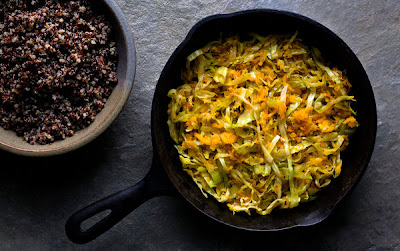
Winter Squash and Cabbage Gratin
THis is adapted from the New York Times recipe, and is a great use of winter vegetables. You can just cook these vegetables in a skillet and serve them with grains for a great vegan dinner, or turn them into a hearty vegetarian (but not vegan) Provençal-style gratin.
For the shredded vegetable sauté:
2 tablespoons extra virgin olive oil
1 pound winter squash, peeled and shredded
1/2 cup chopped onion
3/4 pound green cabbage, shredded
2 garlic cloves, minced
2 teaspoons finely chopped fresh sage
2 teaspoons chopped fresh thyme leaves
1/4 tsp. cayenne powder
For the gratin:
3 eggs
1/2 cup milk
Salt and freshly ground pepper
1 cup cooked barley, rice (preferably brown) or quinoa
2 ounces Gruyère, grated (1/2 cup)
1 ounce Parmesan, grated (1/4 cup)
1. If serving the vegetables with grains, begin cooking the grains of your choice first.
2. Heat 1 tablespoon of the olive oil over medium heat in a large, heavy skillet or a wok and add the onion. Cook, stirring, until it begins to soften, about 3 minutes. Add the shredded winter squash and the garlic and a generous pinch of salt. Cook, stirring often, until not quite tender, about 10 minutes, and add the remaining oil, the cabbage, sage, thyme, and salt and pepper to taste. Continue to cook, stirring often, until the vegetables are tender and fragrant, 8 to 10 minutes. Serve with grains or use the vegetables for the gratin below.
3. If making a gratin, preheat the oven to 375 degrees and oil a 2-quart baking dish or gratin dish. In a large bowl, whisk together the eggs and milk. Add salt to taste (about 1/2 teaspoon) and freshly ground pepper, and stir in the cooked grains (I used cooked purple barley, and it was a beautiful and tasty combination with lots of texture) and the cooked vegetables. Add the cheeses and stir everything together, then scrape into the prepared baking dish.
4. Bake 40 to 45 minutes, or until the top is lightly browned and the gratin is set. Allow to cool for 15 minutes or longer before cutting into wedges and serving.
Subscribe to:
Posts (Atom)


