
Showing posts with label Classic Movies. Show all posts
Showing posts with label Classic Movies. Show all posts
Monday, June 7, 2021
Desiree (1954)


Wednesday, October 14, 2020
Gentlemen's Agreement (1947)

This movie, which centers on a non-Jew claiming to be Jewish so that he could write an expose on antisemitism in New York City post -WWII, is so modern. Especially if you substitute black for Jew. Even so, there is a rise in antisemitism as well. When the commander in chief counts himself amongst the proud boys it is bound to unleash some out in the open prejudice. The move artfully unpeels the onion of the caste system in the US, ranging from the out and out hate speech, to withering glances, and then the subtle "I am not an antisemite but I do think I am better than the Jews". This 70+ year old movie speaks loud and clear about America today.
Sunday, March 10, 2019
Music Man (1962)

The movie takes place in the early 20th century in River City, Iowa (supposedly Cedar Rapids), which is an unusually gifted town musically. Then a con man, Harold Hill, moves to town. His scam is that he sells people musical instruments and the promise of lessons, and once he gets his money, he skips town. This time however he becomes entangled with a woman who desperately wants to believe in him, to the point where what he says will happen does. The town's band, with new instruments and uniforms, is able to sound like they have been practicing together for years. Hill allows them to believe in themselves, and somehow they live up to their best potential. It is kind of silly at heart, but a real feel good movie as well. 76 trombones in the big parade.....
Tuesday, October 23, 2018
Lady Eve (1941)

What is both skillful and irritating about Stanwyck's performance is how she has it both ways. She is a crook, and yet can be trusted. A seductress, and yet a pushover for romance. A gold digger, and yet she wants nothing from him. And he is a naive innocent. She falls for him so quickly and so thoroughly that she's even frank about her methods; just before he kisses her in the moonlight in the ship's bow, she tells him, "They say a moonlit deck's a woman's business office.”
The thing is that we are watching this movie against the background of #MeToo, the stripping of women of autonomy by the current administration and the incredible entitlement of the upper class demonstrated by Brett Kavanaugh. So it fell a little flat.
Wednesday, October 17, 2018
Unfaithfully Yours (1948)

The movie spends most of the time inside the obsessive imagination of its protagonist, an easily excitable and completely self-centered concert conductor . He at first resists the idea that his wife might be unfaithful to him, refusing to look at a private detective, and then his subsequent pathologically jealous state adds vitality to his art. Played by Rex Harrison, the conductor’s mind becomes the stage on which the film’s fantasized events play out, ranging from elaborate traps to the slashing of a razor, from a humble goodbye to Russian roulette. Under the false impression that his faithful and loving wife is cheating on him, he directs his orchestra, and as he does so, he loses himself in the particular mood of the given composition. In a flurry of impassioned emotion shaped by selections from Gioacchino Rossini, Richard Wagner, and Pyotr Ilyich Tchaikovsky, he visualizes himself in a series of sometimes vengeful fantasies. Sturges explores the notion that music not only shapes our mood but that our perceptions of the world are rarely accurate.
Wednesday, April 18, 2018
The Best Years of Our Lives (1946)

There are three threads, one of which is the effects of war on a family. Fredric March was a banker before he went to the European theater and he is one when he comes back. His experiences in war leave him feeling like what he does in his job is fairly trivial, and he has trouble readjusting to civilian life, but is fairly well off with a wife and child who welcome him home. Hoagie Carmichael is a sailor whose ship went down and he was amongst a few survivors. He lost both his hands, which he struggles with fitting back in, despite his family and fiance welcoming him whole heartedly. He finally accepts that he can have the life he left behind and gets married before the end. Dana Andrews is a guy who was unskilled before he went to war, was a hero there, performing well under pressure and then coming home with PTSD and no job prospects. His wife has also moved on without him, and to a large extent, his story seems pretty comparable with modern soldiers. Really, a great film, maybe a tad on the long side, but well worth watching.
Wednesday, July 26, 2017
Kramer vs. Kramer (1979)

My memory of the film was consistent with the content, but the passing years have made it refreshingly surprising that a man solo parenting a child would stand out like it did almost 40 years ago. The story is that Mrs. Kramer is desperately unhappy in her role as mother and wife, and she leaves the family home (or apartment, as this is New York City) and the care of their 6 year old boy is left in Mr. Kramer's very incapable hands. She goes about getting back into the work force, where she had been prior to her marriage, and where she finds her way back to her usual self. He finds his way into parenthood, and it is all well and good until she wants custody. There are some things that are completely unrealistic about this, like how Mr. Kramer manages without any hired help, but it is a very well done window into a time of transition in work and family life in America.
Thursday, March 30, 2017
Sunset Boulevard (1950)

It is a very noir story, beginning with the ending, which is a man face down in the pool. So from the very beginning you know it is not going to end well, and then the story unfolds. An aging silent film star is sequestered in her decaying mansion on Sunset Boulevard when a hard up script writer happens upon her. One thing leads to another and he is in so deep that he can't see a way out. It is painful and slow and beautifully filmed. Step back to another era for a couple of hours with this movie.
Saturday, April 16, 2016
The Treasure of the Sierra Madre (1948)

Bogart is down and out in Mexico when he meets up with two men who he ultimately decides to go off looking for gold with. The Mexican hills are replete with both bandits and federales, either of whom are dangerous to the trio. The most dangerous of all is their greed, however, especially for Bogart. He develops a deep seated mistrust of his partners, and is willing to murder a man who comes upon them. It is the age old story of money causing people to become a worse version of themselves, and while Bogart was warned of this before he sets out, he does not heed those words and it is ultimately his undoing. Huston the father received a Best Supporting Actor Oscar and his son Best Director in the first Academy Award ceremony where father and son were both honored. Well worth watching.
Friday, December 4, 2015
It Happened One Night (1934)

One source of classic movies is the American Film Institutes' list of the 100 Greatest American Films of All Time, and that is where this one comes from.
Ellie Andrews (Claudette Colbert) is a sheltered and naive young woman. She impulsively marries the first man that she is alone with, much to the horror of her over protective father. She is worth millions and her opportunistic groom sees that as part of her attraction. She eludes her father's capture to bring her back for an annulment, and while on the lam she meets the charming Peter Warne (Clark Gable), a newspaper man who helps her in order to get a story. One thing leads to another, and Ellie comes to see that her "husband" might have been taking advantage of her, Peter starts to see the side of Allie that is more than just a spoiled heiress, and after several false starts, they attempt to have a life together with the blessing of Ellie's father. Very fun and light.
Tuesday, December 2, 2014
Cluny Brown (1946)
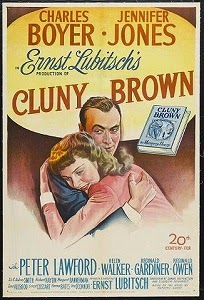
Cluny Brown is an enthusiastic, cheerful, and naive girl who 's greatest talent is for plumbing. That is not a job for a woman, and her uncle quickly gets her a job as a parlor maid in the English countryside, hoping that will keep her out of trouble. Before she goes, she meets Adam Belinski, a Czech writer who has escaped the Nazi's occupation of his country. He is quite taken with Cluny, and coincidentally they end up on the same estate--he as a guest and she as the hired help. The servants have a great deal of trouble with both of them. Cluny doesn't know her place and Belinski treats everyone as equals, and they are a match made in heaven. Belinski knows and eventually Cluny figures it out herself. There are some wonderfully suggestive scenes that got through the scrutiny of the Production Code censors, some well timed comedic dialogue, and a well told story. There are some wonderful characters who make the classism of the English a thing to laugh about rather than marvel at, and it is a very enjoyable movie.
Wednesday, September 17, 2014
Trouble in Paradise (1932)

This is his first talking movie, and it is sensational. One hypothesis about why it fell into obscurity is that it is very suggestive and that starts with the opening credits. The film opens with 'Trouble in" and there is a double bed in the background that is in view for several seconds before the words 'Paradise' appear. So the viewer is immediately clued in that this is going to have something to do with a troubled romance that includes, but is not limited to, sex. Very risque for 1932, or maybe it wasn't and it became so later. In any case, the acting is perfect, a mix of sultry and comic in just the right proportions. If you missed Ernst Lubitsch's work, get this DVD, and don't skip the 47 minute German silent film from 1917, Das fidele Gefangnis (The Merry Jail).
Subscribe to:
Posts (Atom)

