Search This Blog

Saturday, July 10, 2021

Little Green Dress Sauce

This is not much to look at, but it packs a flavor punch and is worth the really unbeleivably excessive time it to put together. While my spouse was pitting olives and amassing the ingredients, many of them being processed separately, I put together two salad for a party of 50 we were having the next day. And prepped for a third. But he served it with a grilled chicken that had a simple herb rub, and it was a big hit. Vivian Howard gives quite a few wasy to use this in her new book "This Will Make It Taste Good". Try not to be put off by the cutsie names and her slightly annoying approach to organization in this. There are some gems to be had here. Ingredients 2 medium shallots 2 garlic cloves 3 tablespoons red wine vinegar ⅔ cup Castelvetrano olives, pitted 1 ½ tablespoons capers, rinsed 2 oil-packed anchovy filets 1 bunch fresh flat-leaf parsley (about 1 cup packed) 2 1/2 ounces packages fresh mint (about 1/2 cup packed) ½ cup tasty extra-virgin olive oil Grated zest of one lemon ¼ cup fresh lemon juice 1 teaspoon hot sauce ½ teaspoon kosher salt In a small food processor mince the shallots and garlic, then stir them together in a small bowl with the red wine vinegar. (We want the shallots to pickle a bit, so set mixture aside about 20 minutes.) Meanwhile, mince the olives, capers, and anchovies in the food processor. Transfer to a medium bowl. Pick the leaves and small stems from the parsley and the leaves from the mint; mince in the food processor. (It may take a little while to get them all fully processed.) Transfer herbs to the bowl with the olive mixture. Add the pickled shallot mixture, lemon zest, lemon juice, hot sauce, 1/2 cup extra virgin olive oil, and 1/2 teaspoon kosher salt to the bowl with everything else. Stir it all together and let the vinegary puddle of green sit for a minimum of 30 minutes before serving. Makes 2 cups.

Friday, July 9, 2021

Boycott Option

I am not one to rush into a political discussion, and I do not follow politics beyond reading articles. I don't have a politics blog that I prefer, and I walk away from discussions that get too heated for my taste. That said, I have been reading and thinking about democracy and what can threaten it. Certainly the insurrection in Washington, DC on January 6th this year, incited by the loser of the election and our president at the time, is something to reckon with. Any politician who supported such a blatant attempt to overthrow a democratically elected government is suspect, and any corporation that supports such a policitian is potentially problematic. Toyota gave $55,000 to 37 GOP objectors this year, and that is definitely a problem for me, even though it is not a lot of money when you think about the huge sums of money in politics. Why? That is a quarter of the bloc that voted to nullify President Biden's win after the Capitol siege. Toyota gave more than twice as much — and to nearly five times as many members of Congress — as the No. 2 company on the list, Cubic Corp., a San Diego-based defense contractor. The Japanese automaker's donations this year included a February contribution to Rep. Andy Biggs, an Arizona Republican who has been one of several vocal election conspiracy theorists. A Toyota spokesperson said in a statement emailed to Axios: "We do not believe it is appropriate to judge members of Congress solely based on their votes on the electoral certification." Why not? Seriously, why not? That is a litmus test for your belief in our form of government.

Thursday, July 8, 2021

Cashew Asian Rice Salad

This is a great rice salad, filled with great vegetables and a flavorful rice. It is the only rice salad that I have had that I thought i might make again. For the Coconut Rice: 1 1/2 cups dry jasmine rice 1 (15 oz) can unsweetened coconut milk 1 clove garlic, minced 1 teaspoon salt 1 cup water For the Salad: 2 red bell peppers, finely chopped 1 (8 ounce) bag shredded red cabbage 1 1/2 cups shredded carrots 1 small red onion, finely diced 1 cup cilantro, chopped 3/4 cup green onions, thinly sliced 1 cup cashews, finely chopped For the Ginger Peanut Sauce: 1/3 cup natural peanut butter 2 tablespoons honey 3 teaspoons freshly grated ginger 2 tablespoons rice vinegar 2 teaspoon sesame oil Water to thin Lime wedges Instructions Rinse the dry rice well until the water runs clear. In a medium-sized pot, mix together the rice, coconut milk, garlic, salt, and water. Bring to a boil. Once the pot reaches a rolling boil, cover, reduce heat to low, and let simmer for 15 minutes. After 15 minutes, turn off heat and let sit (with lid on) for an additional 10 minutes, or until the liquid is absorbed. As you wait for the rice, make the peanut sauce. In a small, microwave-safe bowl, combine the peanut butter and honey. Microwave for 15 seconds, or until the peanut butter thins. Stir well. Add the ginger, rice vinegar, and sesame oil. Stir again. Thin as desired with water. Fluff the rice and combine it with the chopped vegetables and cashews (I reserve a few whole cashews to garnish with, but it’s not necessary). Drizzle with a bit of the Ginger Peanut Sauce and taste– you might not need to use all of it. Serve with lime wedges.

Wednesday, July 7, 2021

The Dig (2021)

This is a beautiful film, with a great story, well told, and the cinematography is brilliant. It is quiet, but really satisfying. The front of the house story is this. It is set in May 1939, as Europe lurched towards war and Hitler on the brink of invasion of Poland. A widow, Edith Pretty (played by Carey Mulligan) hires an amateur excavator/archaeologist Basil Brown (played by Ralph Fiennes), to dig up the huge mounds on Edith's property in Suffolk. She and her now deceased husband bought the property with the intention of finding our what was underneath them and for various reasons that becaome clear later, she doesn't feel like she can wait. Brown is kind to every one. He speaks to the precocious young son of Mrs. Pretty, a boy whose head is filled with stories and fantasies about the cosmos, in such a way as to educate him and make him feel heard. He is a serious excavator used to being taken advantage of, and while he underestimates her at first, Mrs. Pretty does right by him. As he dug, mostly on his own with little help, he came across the skeleton of an 88-foot ship dating to the Anglo-Saxon period. This was the first phase of what has been called one of the most important archaeological discoveries in British archeology. The next phase was discovering the burial chamber within the ship, filled with a treasure trove of almost perfectly-preserved artifacts, made from gold and garnet: a stunning helmet, shoulder clasps, a golden belt buckle. A king must have been buried there, for all the effort to bury him in his ship and all the wealth they left with him. This is a great story of how Pretty sponsored the dig and then donated the artifacts to the British Museum, where they sit to this day, known as the "Sutton Hoo find."

Tuesday, July 6, 2021

Shakespeare in a Divided America by James Shapiro

This book, which the New York Times picked as one of the five best nonfiction books published in 2020, is addressing the fact that America has always been divided, from the very beginning, and then examining what our long standing love affair with Shakespeare tells us. He looks at the popularity of particular plays at particular times, and weaves that in with some specific things that happened in the time period he is examining in that chapter, then brings about some insight into what we can draw from the two things put together. There is the longstanding obsession with Othello at the time of the Revolutionary War, which tells the story of a white woman in love with a black man. The prohibition of such relationships and the apparent shcok related to it does not jive with what was happening in the SOuth, with slave owners raping their slaves and the evidence, their offspring, were irrefutable evidence of their crime. he tells this part through the eyes of a British actress who had to leave because the hypocracy was too much for her to bear. She had a slave owning husband herself, after all. It then goes forward to the Civil War, with several interesting stories, including Ulyssess S. Grant being quite feminine, to the point where he was cast in female roles in Shakespeare plays, which did nothing for his career advancement, and to the assassination of Abraham Lincoln by a Shakespearean actor. Booth played Brutus in Julius Caesar, and he was convinced that people, at least people in the South, would see if as a valiant act on par with Brutus killing Caesar. He was a bad judge of the climate, and was widely villified throughout the United States, the South included. The divide that the author explores throughout the book is the divide between those who think that men are created equal and those that do not. He explores next the changing role of women, and then on to modern politics, but the underlying message is that Shakespeare shows us the range of human behavior, and that we can continue to learn from what his plays contain and tell us.

Monday, July 5, 2021

Bean Salad

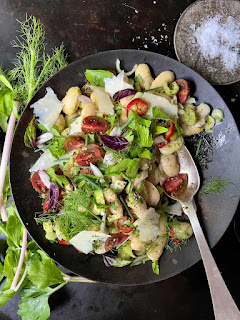
This comes from the author of Open Kitchen and she correctly identified me as someone who stocked up on dried beans during the pandemic. These are made with Corona beans, which are quite enormous and use two things coming out of the garden right now--fennel and garlic scapes. And tomatoes, if you are lucky, which we are not yet. This is suitable for a pot luck or a BBQ. For the dressing: 4 garlic scapes, roughly chopped (1⁄4 cup) 2 tablespoons lemon juice 1 tablespoon red wine vinegar 1⁄2 teaspoon kosher salt Freshly ground black pepper 1⁄4 teaspoon dried oregano 1⁄4 cup Italian parsley leaves, lightly packed 8 tablespoons olive oil Pinch of sugar For the salad: 6 cups cooked beans (see instructions below) 1 cup Castelvetrano olives, pitted and torn in half 11⁄2 cups cherry tomatoes, halved 8 ounces fennel, sliced (2 cups) 1 stalk celery, thinly sliced 1-2 fresno chilies, sliced 11⁄2 ounces shaved Parmesan Fresh herbs to finish, such as chives, parsley, basil, celery leaves 1 In a mini food processor, blend all of the dressing ingredients until smooth. 2 In a large bowl, combine the dressing with the beans, olives, tomatoes, fennel, celery, and chilies. Top with parmesan and herbs. To cook dried beans: Cover 1 pound of dried beans with at least 4 inches of water in a large saucepan. Bring to a strong boil, turn off and let sit for at least 1 hour. Drain, rinse, and put the beans back in the same pot, and cover with at least 3 inches of water. Add 1 stalk of celery, 1⁄2 an onion with the base of the roots intact, 2 cloves of garlic, 1⁄2 teaspoon of salt, and bring to a strong boil. Stir and simmer over low heat until tender (time will vary depending on the type of bean you have, but these large corona beans took 1 hour and 15 minutes). Let the beans cool in their liquid until just warm, then drain and rinse them before adding to the salad.

Sunday, July 4, 2021

George III and Edmund Burke

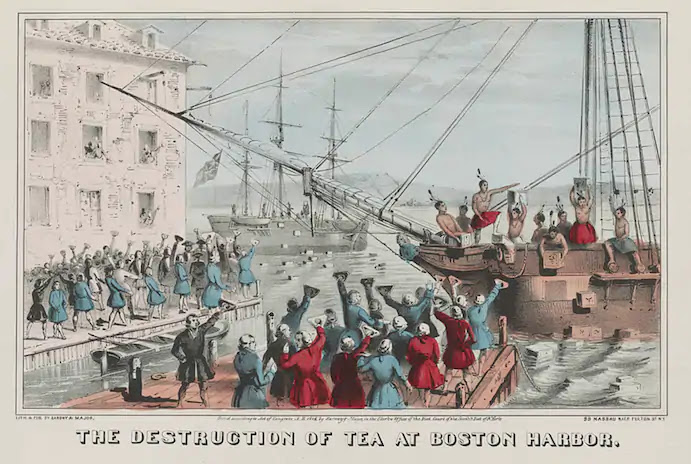
What was the role of King George III in the abruption of America from Britain? Was the revolution against a tyrannical and possibly mad leader? Probably not the whole story. George had some strikes against him from the get go. He was reportedly crippled by shyness, which is a hard row to hoe for a future king. His mentor and teacher became more powerful when George assended to the thrown at age 12, and played an outsized role even after he reached the age of majority. There have been a lot of theories about King George III, that he was a devoted family man and poorly understood, but a prominent politician of the time, Edmund Burke, the so called father of conservatism, thought he was the devil incarnate, a cruel leader and a poor politician. The retaliation of England towards America in the aftermath of the Boston Tea Party led to hardening opposition to Britain's rule. King George III was blamed but really it was the attitude of Parliament couple with an underestimation of the strength of the foe that led to the Declaration of Independence. Was King George in control of his faculties? In 1969 it was proposed that the episodic madness suffered by King George III (1738–1820) resulted from an acute hereditary porphyria, variegate porphyria, caused by deficiency of protoporphyrinogen oxidase. The diagnosis was based on the historical archive and a re-examination of the medical evidence and the appearance of new historical material have suggested that porphyria did indeed exist in the Royal Houses of Europe. The more recent analysis of hair obtained from George III contained no genomic DNA, but metal analysis revealed high concentrations of arsenic. Since arsenic interferes with heme- metabolism, it might have contributed to the King's unusually severe and prolonged bouts of illness. He may have gotten arsenic in the context of the medication George III received from physicians.

Saturday, July 3, 2021

Representation and Taxation

The Boston Tea Party continues with valuable lessons even to today. It all started when the British decided that the colonists were not pulling hteir weight and that they should to start paying their fair share of public expenses. Depending on how you look at it, they had a point. Defense of the colonies, from the French and the people who already lived there, had cost a pretty penny and if you were looking at it as investment property in the short haul, then you were definitely not getting your money's worth. If the long view was that in order to benefit from the land you had to retain it, then making the few people who lived there cover the upfront costs was going to be a hard sell. The colonists themselves weren’t opposed to taxation in principle; they were angry that they had no official say in the matter, since they had no seats in the British Parliament. So it brought to the forefront the unfairness of taxation without representation, which is essentially what Washington, DC has today. The fact that we didn't have a vote in what happened to us led us down the path to revolution. It would behoove those who are actively seeking to restrict voting and thereby tax and fail to allow representation to remember our past.

Friday, July 2, 2021

Libertie by Kaitlyn Greenidge

This is a good Independence Day weekend book to read. The book is inspired by the life of Susan Smith McKinney Steward, the first Black woman doctor in New York State and the third in the country, and her daughter, who married the son of an Episcopal bishop from Haiti. Libertie’s hometown is based on the real nineteenth-century community of Weeksville, a town of free Blacks in Brooklyn during Reconstruction. Libertie's mother has a mystical quality to her, but while she can heal the body, the spirit that has bewen harmed by slavery does not heal so easilty. There are a lot of layers to this book, but the story itself is about a mother-daughter relationship, wrapped in an exploration of race, gender, and colorism. Libertie's mother would like her to follow in her footsteps as a physician and a healer. She is not as gifted as her mother, and she struggles in school. When she ends up failing out of college, Libertie makes the rash decision to marry her mother’s protégé Lucien Chase, the son of an Episcopal bishop, and follow him to Haiti. She hopes that Haiti, as a Black-led republic, will offer her a different life than she can find in the U.S., but soon discovers that the island has its own problems and is still not free of the bitter disease of colorism. It is beautifully written, suffused with layers of hurt and pain.

Thursday, July 1, 2021

Graduating From The July Effect

This is the first year in almost 40 years that July 1st is just Canada Day. As a medical student, resident in training, academic physician, and for almost 20 years in charge of some aspect of the training program, July 1st was the first day of a new year. There was a time when it was the year that counted the most, so much more so than the changing of the calendar. As I inch towards retirement, I have taken a step back from a job with more headaches than rewards and found one that is slower paced, with more collegiality and less in the way of day to day drama. There are things that I miss about being involved with a training program, specifically the trainees themselves, and I have made an effort to seek out some options to do a little bit of that, but today it strikes me that July is just not what it used to be to be, and I can even consider taking the weekend off sometime soon. That was never an option when I was in charge of the incoming residents--it was their first and most terrifying day of work, after all. The only problem is that I am not in love with traveling in the heat of the summer (maybe there were things about my old job that really did suit me!). In any case, it is complicated to change what you do, especially when you did it as long as I did, but it is also important to plan for a future with more leisure and today it feels like I am taking one more step in that direction.