Wednesday, October 10, 2012
The Garden Of Evening Mists by Tan Twan Eng
This is the fourth book longlisted for the Man Booker Prize this year that I have read, and the second by the author. He is a Malaysian and both his books have been set there, and set within the context of WWII. One thing that comes through loud and clear is that the legacy of colonialization is complex, and it leaves many enemies in it's wake. The 'liberators' of today become the 'oppressors' of tomorrow. It is an oft sung song, but the tone and content are different in this particular setting. The war has just ended, but that means tha no one is officially fighting. It does not mean that the atrocities are over, and it most certainly doesn't mean that the memories of the war have faded in any way. The voice of the novel is Teoh Yun Ling, a Girton-educated retired judge in independent Malaysia, born in 1923 and brought up among the loyal colonial elite (“the King’s Chinese”) of Penang. After the Japanese invasion, she is taken to a brothel with other underaged girls, raped repeatedly as a “Guest of the Emperor”, and then sent to spend the rest of the war in a remote jungle prison camp. She escaped, but her beloved sister Yun Hong did not. At the end of the war the Japanese killed all remaining prisoners, and while Yun Ling fulfilled her promise to her sister to escape, she did not escape her survivor guilt for having done so. Yun Hong's path to healing comes from an unexpected source. She meets another who is seeking redemption. Aritomo is an enigmatic former gardener to the Emperor of Japan working to restore a destroyed Japanese garden for an unbidden master. Yun Hong wants him to build a garden for her sister, but he will not do it. Instead, he takes her on as an apprentice and tells her “Every aspect of gardening is a form of deception”. Well, he is deceiving her--he is ostensibly teaching her the art of outdoor deception while he is helping her to heal. Initially he is the enemy, based solely on his country of origin, but in the end she sees that he has saved her. He leaves her with a work of his art that she seeks to preserve. The writing is ethereal. It transports the reader to a place that feels very different and foreign, but also pleasant and soothing, despite the very traumatic material it describes. Magnificent.
Tuesday, October 9, 2012
Maple Walnut Tart
I spent Columbus Day weekend baking with Ivy.
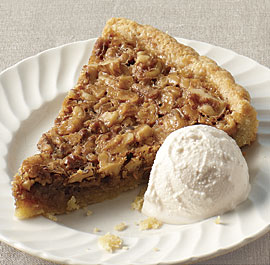
8 oz. (1-3/4 cups) unbleached all-purpose flour; more for rolling
1 Tbs. granulated sugar
1/2 tsp. kosher salt
6 oz. (3/4 cup) unsalted butter
1 large egg yolk
1/4tsp. fresh lemon juice
3 to 4 Tbs. ice water
For the filling:
2 large eggs 3 large egg yolks 1 tsp. pure maple extract 1/2 tsp. pure vanilla extract 1/4 tsp. kosher salt 1 cup pure maple syrup 3/4 cup granulated sugar 2-1/2 oz. (5 Tbs.) unsalted butter 8 oz. (2 cups) chopped walnuts, toasted --------------------------------------------------------------------------------
Make the dough:
Pulse the flour, sugar, and salt in a food processor once or twice to combine. Add the butter and pulse until the mixture is pebbly, with some pea-size bits of butter. In a small bowl, whisk together the egg yolk, lemon juice, and 3 Tbs. of the ice water. Pour the mixture through the feed tube of the food processor, pulsing to combine. The dough mixture should be moist but should not come together into a ball. If a small handful of dough pressed together does not adhere, add the remaining 1 Tbs. ice water, pulsing to combine. Turn the dough mixture onto a piece of plastic wrap; gather the plastic around the dough, pressing the dough into a disk. Wrap tightly in additional plastic wrap and refrigerate for at least 1 hour and up to 2 days. Before rolling, let the dough stand at room temperature for about 15 minutes to become pliable. Lightly coat a rolling pin with flour and roll the dough on a lightly floured surface into a 15-inch circle. Lightly coat a round 9 x1-inch fluted metal tart pan with a removable bottom with cooking spray. Roll the dough around the rolling pin and carefully unroll over the tart pan. Gently press it into the bottom and up the sides of the pan without stretching. Trim the excess, leaving a 1-inch overhang. Fold the overhang inside the tart and press against the sides to make a double wall about 1/4 inch higher than the tart pan (this will offset any shrinkage during baking). Wrap the tart shell in plastic wrap and refrigerate for at least 30 minutes and up to 24 hours. Position a rack in the lower third of the oven and heat the oven to 425°F. Line the tart shell with parchment and add enough beans or pie weights to fill the shell. Bake on a heavy-duty rimmed baking sheet until the edges are firm and starting to brown, 15 to 20 minutes. Carefully lift the parchment and weights from the tart shell. Continue to bake until the bottom of the shell is pale golden, 5 to 7 minutes more. Let cool on the baking sheet on a rack and reduce the oven temperature to 350°F.
Make the filling:
In a medium bowl, whisk together the eggs, yolks, maple and vanilla extracts, and the salt. Set aside. In a 2-quart saucepan, combine the maple syrup and the sugar and cook over medium-high heat, stirring constantly until the sugar is dissolved and the mixture just starts to boil, about 3 minutes. Reduce the heat to medium and add the butter, stirring until melted. Remove from the heat and let cool for 1 minute. Slowly whisk the warm syrup into the egg mixture, drizzling it in about 1/4 cup at a time and whisking continuously to prevent the hot syrup from cooking the eggs. Fill and bake the tart Fill the tart shell with the chopped walnuts. Carefully ladle the filling over the walnuts to within 1/4 inch of the rim (do not overfill; there may be a little filling left over). Bake the tart until it is just set in the center, 30 to 40 minutes (if the crust is golden-brown before the filling is set, cover the edges loosely with foil). Cool completely on the baking sheet on a rack.
Monday, October 8, 2012
Young Adult (2012)
This is a very interesting, more than slightly dark comedy on the theme of 'peaked in high school'. Mavis (Charlize Theron, in yet another role where a very pretty woman does not look her best) is the complicated focus of the movie. She is a character that does not bravely overcome adversity but rather openly causes adversity to those around her. The nuance here is that we feel sorry for her rather than hating her guts.
Mavis is the ghost writer of a once popular young adult book series, but now the series is ending, she has writer's block, and really, her life is a complee mess. We can see from the moment the film begins that while she is still a very pretty woman, she really does not have much else going on. She is drinking like crazy, and she appears to have no friends.
So what does she do? She decides that she is goin gto get back together with her high school boyfriend. I guess the theory is to go back to the last time that your life felt perfect, and then start over. Never mind that he is now married and has a newborn baby girl. Details. Surely he will go along with this plan.
Well, it is not a well laid out strategy for getting your life back on course, and it fails spectacularly, but along the way there is a fair amount of entertainment--and in the end you really truly never want to be this girl, that is for sure.
The script is written by Diablo Cody, whose work in 'Juno' was spectacular, and I was very much in love with this effort as well--I know, it sounds a little depressing, and it probably is depressing if your life peaked in high school, but if it didn't then you might just love this as much as I did.
Sunday, October 7, 2012
Middlemarch by George Eliot (1871)
I am in the midst of doing a lot of college reading. Perhaps it is a way to go back to college as a middle aged woman without having to take the time to go to class--I am doing all the reading for two courses that two of my sons are taking. I don't have to sit in class (which I of course have no time to do at this point--seriously, doing the reading is a task that I have some struggles with some weeks!), but I have someone else (a college professor, no less) guiding my reading selections, and I have someone to talk about it with. So far (and we are at midterm) it has been grand. And it is in this context that I read 'Middlemarch'. Coincidentally it appeared on a list of 100 books that you should read before you die, and while I might quibble with some of the selections on it, this is a sweeping Victorian novel that should not be missed. The novel came out serially--which poses some challenges to the author--Dickens combated it with constantly recapping the action, but what Eliot does is create a book about a place, and then the people in it come second. The sections concern various groups of interconnected people, and the overarching theme, beyond the social structure and expectations of Victorian England, is finding satisfaction in life. In Eliot's mind, that seems to be strongly tied to making the right match in life--which is not so much finding the right person, but finding a person who will stick with you through thick and thin. The book she has written gave her ample opportunity to expose us to a number of choices, many of which are quite relevant today (hence the edurance of the novel over time--like Shakespeare, the themes still speak to us). It is a dense read--it is a slow 880 page novel. But there is much to savor here, and the book is neatly wrapped up at the end, so we are not left hanging as to what happened to everyone.
Saturday, October 6, 2012
Civil Disobedience by Henry David Thoreau (1845)
I have been reading some very interesting primary material with my son who is taking a class on understanding American culture. I have not read this essay in over 35 years, and it is funny how differently it resonates with me now than it did when I was in high school.
My younger self saw Thoreau as a bit of a romantic. He lived in relative isolation on his now famous Walden Pond, keeping meticulous records of all that he did and spent. He seemed very idealistic to me, in that he refused to pay taxes for things that he did not agree with and went to jail for his principles.
My middle aged self sees him as a libertarian, someone who advocated for the elimination of government altogether. He was not contributing to the greater good so much as he was acting like his ideas were the only ones worth having, and he certainly was not about to support someone other than himself in all this. His one point of redemption is his opposition to slavery, but in reading this essay, that is by no means the main point, or even the driving force in his actions. He just doesn't want to be part of a society, and doesn't acknowledge what the society does for him. I have crossed him off my future reading list.
Friday, October 5, 2012
Ping Pong (2003)
I first saw table tennis played seriously when I was in high school. Up until then I played it in an almost desultory manner, whereby my body rarely left contact with the playing surface, I was that close to the table at all times. One of my high school friends was Asian, and some of my favorite memories are times we spent at an Indonesian family friend's. The reasons are two-fold. The food was incredible, voluminous, and almost overwhelming in it's abundance (when I encountered Rijsttafel on a future trip to Holland, I was almost underwhelmed--the real Indonesian table groans with food). The second was that the sons played ping pong like I had never seen it played before. Unbelievably, they worked up a sweat playing, and they were a body length away from the table when the action heated up. It was breathtaking to watch table-side.
Since that time, the only exposure that I have had to table tennis like that is at the Olympics. This film is set in Japan, and the main characters have been playing ping pong all their lives. It is a part of how they express their personalities. The friendship is between Peco, a cocky youth, and his introspective childhood friend, called 'Smile' because he never does. Smile has great talent and Peco has confidence--when Smile lets his talent out, he crushes Peco's confidence, and the movie is about how Peco claws to get it back. There is a lot of cultural context to be found in the background of the movie, and the story of how their relationship with each other and the game evolves over time is very good.
Thursday, October 4, 2012
Reflections on a Middle Child
Stereotypes about middle children are hardly flattering. They're often described as confused underachievers, overshadowed by older and younger siblings, and overlooked by their parents.
I have two middle children (way to maximize an oft maligned group, I know--my spouse is a middle child, and the offspring were decidedly his idea), and one of them has a birthday today. I am reminded of what one of friends so aptly said--I cannot believe this man was once inside my body. Seriously? It seems so improbable now.
In thinking about middle children, I read about some really good things about being in the middle of a sibship. One is that you get to be better at negotiating. Why? Because it is the only strategy open to you. The eldest child tends to have a certain amount of authority based solely on being older, and they also tend to be physically larger--so they get their way through brute force or just because they are the parent's default option. The youngest tends to get upset if they don't get their way.--and the parents are exhausted from holding the line against the other kids, and realize that they no longer need to set a good example, as this is the youngest kid. Just give in is a common parental strategy for youngest children. For the middle child, neither of those strategies are available. So they often get very good at negotiating, figuring out what the other person wants and needs, and then managing to get them what they want and what the middle child themselves want at the same time. And, of course, one of the things that middle children often want is peace and calm and quiet and for everybody to get along. And so those traits then serve them well when they leave the family. That sums up this middle child as an adult. Joyeux Anniversaire, mon fils. Go forth into the world and spread an eery calm upon all that you meet.
I have two middle children (way to maximize an oft maligned group, I know--my spouse is a middle child, and the offspring were decidedly his idea), and one of them has a birthday today. I am reminded of what one of friends so aptly said--I cannot believe this man was once inside my body. Seriously? It seems so improbable now.
In thinking about middle children, I read about some really good things about being in the middle of a sibship. One is that you get to be better at negotiating. Why? Because it is the only strategy open to you. The eldest child tends to have a certain amount of authority based solely on being older, and they also tend to be physically larger--so they get their way through brute force or just because they are the parent's default option. The youngest tends to get upset if they don't get their way.--and the parents are exhausted from holding the line against the other kids, and realize that they no longer need to set a good example, as this is the youngest kid. Just give in is a common parental strategy for youngest children. For the middle child, neither of those strategies are available. So they often get very good at negotiating, figuring out what the other person wants and needs, and then managing to get them what they want and what the middle child themselves want at the same time. And, of course, one of the things that middle children often want is peace and calm and quiet and for everybody to get along. And so those traits then serve them well when they leave the family. That sums up this middle child as an adult. Joyeux Anniversaire, mon fils. Go forth into the world and spread an eery calm upon all that you meet.
Wednesday, October 3, 2012
Judging an Iowa Judge
Here is the deal. After Iowa legislators hurried to pass a local so-called Defense of Marriage to prohibit marriage between gay and lesbian couples to avoid a similar court challenge, a lawsuit was filed on behalf of six same-sex couples and their children who were denied marriage licenses in Iowa, arguing that this denial violated the liberty and equal protection clauses in the state constitution. In 2007, the Polk County District Court ruled in favor of the couples, prompting the county to appeal to the Iowa Supreme Court. On April 3, 2009, the Iowa Supreme Court unanimously upheld the District Court holding that there was no important government interest in denying citizens marriage licenses based on their sexual orientation.
What to do? Well, for many of us it was cause for celebration. Iowa is not known for being socially progressive, and suddnely we found ourselves in the very important first 10% of states in the country where you could legally marry regardless of gender. The decision was made on the basis of equal protection, placing it where it belongs in my opinion. A civil right.
Not everyone saw it that way. There developed a movement to oust the 'activist' judges--you mean the ones that uphold the Iowa Constitution? That can't be good, said outside agitating religious right money--and they successfully made their argument, which went unopposed, and the three judges were voted out. Oddly, also in accordance with the Iowa Constitution, there was also a referendum on convening a constitutional convention--such a referendum is on the ballot every ten years, and it was voted down. That would be another path to success for those who oppose same sex marriage, and it is a path that is much harder to get to through the legislature, but since they were not Iowans, they didn't even understand the options open to them. Lucky for us.
Now Judge Wiggins, another Supreme Court Judge, is up for reaffirmation, and once again Bob Vander Plaats, joined by Rick Santorum, are spreading their distorted message across Iowa--but this time they are being trailed--literally--by a bus load from the Iowa Bar Association, who are going to each and every town right afterwards and educating people on why laywers in Iowa support Wiggins, and support the decision the Iowa Supreme Court made based on the law. Way to go!
Tuesday, October 2, 2012
Mixed Greens Gumbo
My husband came home from the Farmer's Market with a large bag of fall vegetables, and I had no room for them--all the things that I bought at last weeks Farmer's Market but had yet to use were taking up all the available space in the second fridge. What to do?
I made a variation of the Mixed Greens Gumbo that I found in 'Eat Greens', because that was going to reduce the volume the best.
3 onions, diced
3 Tbs. olive oil
1/4 cup flour
1 pepper, diced
4 cloves garlic, minced
1 cup celery diced
2 bunches of greens sliced into ribbons--I used kale and swiss chard
5 small okra, sliced
1/4 tsp. cayenne
2 Tbs. file
8 c. stock
Tabasco sauce to taste
Saute the onions in olive oil til browning. Add flour and stir until the flour is browning a bit. then add celery, peppers, garlic (and I actually added a bit of cauliflower that was looking a bit sad and I thought would have to be composted if I did not find a home for it soon--it was a delicious addition). Saute until soft. Add the file and cayenne, stir until they are starting to brown a bit, then add the stock, the okra, and the greens. Cook over medium heat uncovered until all the components are cooked and the sauce has thickened. Serve in a bowl with a small pile of rice in the middle. This is a nice alternative to shrimp or chicken gumbo for the vegetarians in the crowd.
I made a variation of the Mixed Greens Gumbo that I found in 'Eat Greens', because that was going to reduce the volume the best.
3 onions, diced
3 Tbs. olive oil
1/4 cup flour
1 pepper, diced
4 cloves garlic, minced
1 cup celery diced
2 bunches of greens sliced into ribbons--I used kale and swiss chard
5 small okra, sliced
1/4 tsp. cayenne
2 Tbs. file
8 c. stock
Tabasco sauce to taste
Saute the onions in olive oil til browning. Add flour and stir until the flour is browning a bit. then add celery, peppers, garlic (and I actually added a bit of cauliflower that was looking a bit sad and I thought would have to be composted if I did not find a home for it soon--it was a delicious addition). Saute until soft. Add the file and cayenne, stir until they are starting to brown a bit, then add the stock, the okra, and the greens. Cook over medium heat uncovered until all the components are cooked and the sauce has thickened. Serve in a bowl with a small pile of rice in the middle. This is a nice alternative to shrimp or chicken gumbo for the vegetarians in the crowd.
Monday, October 1, 2012
The Five Year Engagement (2012)
Ok, this is not a movie with a deeper meaning. You won't wake up six weeks after seeing it still thinking about it. that said, I found it to be entertaining, as well as containing some relationship truths that don't often get into the romantic comedy genre.
Here's the story: Jason Segel is a San Francisco sous chef, Tom Solomon, and Emily Blunt is Violet Barnes, a doctoral candidate in psychology and Tom's fiancé. The premise is that juggling two careers can be trecherous.
Tom is on the verge of being the head chef at a new restaurant, while Violet gets into grad school in Ann Arbor. Tom say no problem, I can cook anywhere. Only it turns out he can't. He ends up making sandwiches at Zingerman's and hating his life. Which he is loath to tell Violet about, and at first she doesn't notice, but when he starts hunting with a stay at home dad, serving only meat he has personally shot, foraging for greens, and making mead that he serves out of his own homemade vessels, she can't ignore it. Still he refuses to engage in a discussion about how they might compromise in an attempt to find mutual happiness, and the relationship waivers. It is on the fence for a while, but then comes back with an amuzing bang at the end. I agree with reviews that this could have been a 90 minute movie, but I wasn't dying for it to end, and it was a pleasant but not sugar coated look at relationships.
Here's the story: Jason Segel is a San Francisco sous chef, Tom Solomon, and Emily Blunt is Violet Barnes, a doctoral candidate in psychology and Tom's fiancé. The premise is that juggling two careers can be trecherous.
Tom is on the verge of being the head chef at a new restaurant, while Violet gets into grad school in Ann Arbor. Tom say no problem, I can cook anywhere. Only it turns out he can't. He ends up making sandwiches at Zingerman's and hating his life. Which he is loath to tell Violet about, and at first she doesn't notice, but when he starts hunting with a stay at home dad, serving only meat he has personally shot, foraging for greens, and making mead that he serves out of his own homemade vessels, she can't ignore it. Still he refuses to engage in a discussion about how they might compromise in an attempt to find mutual happiness, and the relationship waivers. It is on the fence for a while, but then comes back with an amuzing bang at the end. I agree with reviews that this could have been a 90 minute movie, but I wasn't dying for it to end, and it was a pleasant but not sugar coated look at relationships.
Subscribe to:
Posts (Atom)


