Search This Blog

Saturday, September 5, 2015

Novodevichy Convent, Moscow, Russia

Located on the banks of the Moscow river, this is where Russians sent their troublesome women for centuries.  The Novodevichy Convent was founded by Grand Duke Vasily III in the 1520s to mark the liberation of Smolensk and returning it to the Russian State in 1514. The Convent was dedicated to the Icon of the Mother God of Smolensk ‘Hodigitria', the highest shrine of Russian orthodoxy.  It also became one of the most respected and rich nunneries, joined by women of tsarist  families--and sometimes they were sent there against their will.

The end of the 16th century was active for the Convent related with the coronation of Boris Godunov, and his sister Tsarina Irina taking monastic votes. This is the period for the construction of the surrounding stone walls with towers. Toward the end of the 17th century, there was another period, which resulted in the construction of new buildings. During this period, Princess Sofia Alekseevna assisted her brother Fedor to govern the country. After his death she continued to govern for seven more years. She was later confined there by Peter the Great, along with his unwanted first wife. The walls and towers were now rebuilt, partly using the old masonry, and decorated with elaborate crowns in red brick, reflecting the ‘Moscow baroque' style. 

Friday, September 4, 2015

Red Square, Moscow, Russia

Red Square is so spectacularly beautiful it will take your breath away.  It's elegance is not diminished by it's proximity to the Kremlin, which is stunning as well.  Today it stands tall and holds it's own.  It had a humble beginning.  Red Square began life as a slum, a shanty town of wooden huts clustered beneath the Kremlin walls that housed a collection of peddlers, criminals and drunks whose status left them outside the official boundaries of the medieval city. It was cleared on the orders of Ivan III at the end of the 1400's, but remained the province of the mob, the site of public executions, and rabble rousing, until much later. 
The square's name has nothing to do with communism or with the color of many of its buildings. In fact it derives from the word 'krasnyi', which once meant 'beautiful', and has only come to mean 'red' in contemporary Russian. The name became official in the middle of the 17th century - previously it had been Trinity Square, due to the Trinity Cathedral, the predecessor of St. Basil's. Popularly, it was also known as 'Fire Square', reflecting the number of times medieval Moscow burned.  The Russians use of wood for building left it vulnerable to burning, something that the Tartars took great advantage of, but the change to brick did help. 

Thursday, September 3, 2015

Among Ten Thousand Things by Julia Pierpont

There has been a fair amount of hype around this book and in the end when I am reflecting on it, I am not sure that it was all that deserved.  The central theme of this book is what exactly ends a marriage.  That can be a tough question to answer concisely because it is usually a whole series of things that add up to more negatives than positives, and then there is a tipping point, beyond which it is hard to salvage things.  In this book the tipping point is that the children find out in the most explicit of ways about their father's infidelity.


Jack Shanley is an self-centered middle-aged artist and father-of-two who has been sleeping with one of his models.  His wife Deborah has known about the affair for months, and they have been working to see if their marriage can be salvaged.  At the opening of the book Jack's mistress sends a package to Deborah that contains a letter delineating the intimate affairs of Jack's life that she is privy to, and then there are copies of the emails that she and Jack have exchanged.  These are very sexually explicit and meant to wound Deborah.  What happens is that Jack's daughter opens the package and reads them, then shares them with her brother, who brings them to his parents attention.  So the children are inserted into the equation and they have more information than is ideal.  It derails the reconciliation process and has a permanent effect on all the relationships within the family.  A cautionary tale for those who step outside the boundaries of marriage about just what they are risking.

Wednesday, September 2, 2015

My Old Lady (2014)

This is a movie with great actors, a sad story, and while it doesn't immediately grab you, it definitely grows on you.  Mathilde (played by Maggie Smith) lives in an enormous apartment in Paris with her middle-aged daughter Chloe (played by the wonderful Kristin Scott Thomas, whose French is as impeccable as her acting).  They are visited by Mathias (played by Kevin Kline), who is nearing sixty and has very little to show for it.  He believes that he has inherited the apartment from his wealthy and estranged father.  But in fact he has not.  His father bought the apartment 43 years before in an arrangement called a viager.  The buyer pays a monthly fee to the seller up to the seller's death, and the seller retains control of the property until death.  So Mathias has to come up with a couple thousand euros a month not to lose the whole thing.

That is the text.  The subtext is about the devastating effect that secrets can have on whole families.  Mathilde and Mathias' father had a long standing secret that they thought had no effect on those around them, but in fact it did.  Very much so.  The selfishness of Mathilde is so palpable, and is only surpassed by her smugness.  It is well scripted, well acted and thought provoking.

Tuesday, September 1, 2015

St. Basil's Cathedral, Moscow, Russia

I did not think that Moscow would capture my imagination, but I knew that I would love Saint Basil's Cathedral.  This is what I thought of when I pictured Russian architecture.


St. Basil's was built to commemorate the capture of the Tatar stronghold of Kazan in 1552, which occurred on the Feast of the Intercession of the Virgin. I will say this time and again, but the expulsion of Tatars from Russia, which happened long long ago is still considered quite a big deal.  They really did a number on the Russians and there is no forgetting the getting rid of them. 


The cathedral was thus officially named Cathedral of the Intercession of the Virgin by the Moat (the moat being one that originally ran beside the Kremlin), but it is popularly known as St. Basil's Cathedral, after St. Basil the Blessed (a.k.a. St. Basil Fool for Christ; 1468-1552), almost from the beginning. Basil impressed Ivan in 1547 when he foretold a fire that swept through Moscow that year. Upon his death, Basil was buried in the Trinity Cathedral that stood on this site at the time.
The Cathedral of the Intercession a.k.a. St. Basil's Cathedral was constructed from 1555 to 1560. Legend has it that after it was completed, Ivan had the architect blinded in order to prevent him from building a more magnificent building for anyone else, which goes a long way to explaining why he was known as Ivan the Terrible.

In modern times, St. Basil's came very close to being removed by Stalin, who reportedly didn't like that it prevented his soldiers from leaving Red Square en masse. The architect Baranovsky saved the day for all of us who love this view by standing on the cathedral's steps and threatening to cut his own throat if the masterpiece was destroyed and Stalin relented.  Baranovsky spent five years in prison for his defiant act, but as punishment meted out by Stalin goes, that is small potatoes.

Monday, August 31, 2015

The Green Road by Anne Enright

This book was long listed for the Booker prize this year, but I would have picked it up to read anyway, because I like this author.  She is Irish and she is a chronicler of the modern Irish experience. Her books that I like best are set in her homeland, and this is no exception to that rule.


The story chronicles the five living members of the Madigan clan.  Rosaleen is the mother and her four children are Dan, Emmet, Constance and Hanna.  Hanna and Constance live in Ireland and Dan and Emmet do not.  The Irish diaspora is well represented here, as are the varied textures of differences that exist within families.  Dan is gay, Emmet is commitment avoidant and perhaps intimacy impaired as well, Hanna is an alcoholic, and Constance is the child who pretty clearly will take care of Rosaleen when the time comes.  The book introduces them each on their own, and then brings them together under one roof for Christmas when Rosaleen decides to sell her house.  She does so in order to give each of her children money because none of them seems to be able to manage that on their own.  The writing is at once direct and lyrical.  The one thing it lacks is an ending that ties it all together, but that is an acceptable flaw in my mind.


Sunday, August 30, 2015

While We're Young (2014)

Whenever someone does a movie about aging and tries to both get it right and to be funny, it is a fine line that is fraught with difficulty.  This movie has an excellent cast and it really does a good job of being occasionally very funny about a couple coming to grips with middle age. 
Josh (played by Ben Stiller) is a slightly obsessive, slightly narcissistic documentary film maker with almost no sense of humor about his work and less of one about aging.  When his doctor tells him he has arthritis in his knee he is so incredulous he thinks it is some other sort of thing that they are using that word to describe but it could not be degenerative joint disease.  His wife Cornelia (played by Naomi Watts) is a film producer and the daughter of a famous documentary filmmaker (played deftly by the wonderfully understated Charles Grodin). 
They are getting old, they were unable to have children, and their friends are having babies in their forties, which is of course exhausting them and making Josh and Cornelia feel left out.  Into that void step Jamie (played by Adam Driver) and his wife Darby (played by Amanda Siegfried--this movie has a great cast).  Jamie is an aspiring documentary film maker, and while the younger couple invigorates the older couple, you can see that it is not going to end well for Josh.  The ending is largely what you would expect it to be, but the dialogue is crisp and real and the whole thing is well worth watching, especially if you fall into Josh' demographic.

Saturday, August 29, 2015

Stalin's Seven Sisters, Moscow, Russia

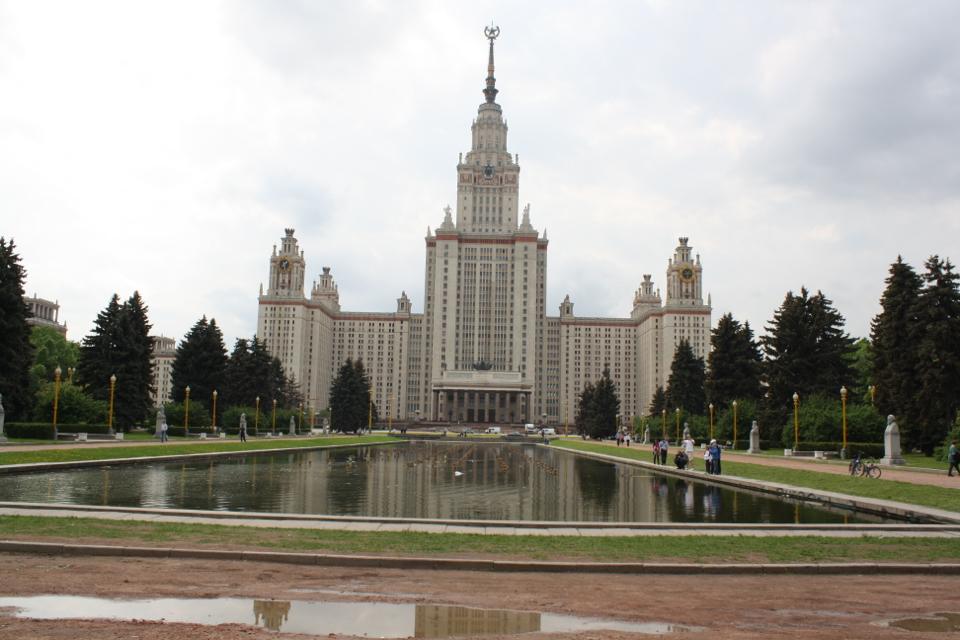
It turns out that I find some aspects of Stalin's architectural projects appealing.   The Moscow skyline is largely defined by the seven towering skyscrapers nicknamed “The Seven Sisters.” Also known locally as “Stalinskie Vysotki” (Сталиские высоткиStalin’s High-rises), they are one of the leading architectural legacies of the Stalinist period in the city. The Soviet Baroque architecture that The Sisters embody is seen by some as unattractive (as stated above, not myself); the buildings themselves are somewhat controversial due to the fact that some see them, with their looming size and towering spired spires, as  reminders of the grim Stalinist repression. However, while debate still continues on whether these buildings are beauties or beasts, there is no doubt that they have become a major representation of the Soviet era and modern-day Moscow.  Pictured here is the sister that is the university, and from this spot, you can see the other six sisters.  The only one that I went into was the Hilton that is near the Moscow train station--it has a marble lobby and high ceilings that you would expect from looking at the exterior.  These buildings were solidly built in the post WWII era and serve as a reminder of what communist architecture was all about in Russia.

Friday, August 28, 2015

The Marrying of Chani Kauffman by Eve Harris

I loved this book.  Maybe I finished it in a day because it is steeped in Orthodox Judaism, but maybe not.  There are two relationships that the book revolves around.  The first is the marriage of Chani Kauffamn, who at 19 is closing in on spinsterhood.  She started off her marriage search being sought after, but after a number of rejections her suitors start to reject her.  That spells trouble not just for her but also for her numerous younger sisters.  So when Baruch shows interest in her, she is motivated.  While their time together is highly regulated, they do get a glimpse of each others personalities, and to the reader it seems like a good match.

Baruch's mother couldn't disagree more.  She makes a point of inserting herself into the process in a way that is out of keeping with the cultural rules of courtship and she does two things in the process.  She gives Chani some power over her because she wants it to be a secret, and she shows her hand.  Chani doesn't have to pretend to like her future mother-in-law.  She just has to woe Baruch.

The other couple int he book are a rabbi and his wife from Chani and Baruch's community.  They started off their lives together in Jerusalem and they didn't always follow the rules.  Now the rabbi is choking his marriage with his increasing piousness and while he knows that it is killing his marriage, he cannot stop himself.  While one relationship blooms the other is dying on the vine.  Very well written.

Thursday, August 27, 2015

Danny Collins (2014)

Al Pacino does an admirable job of portraying an aging rock star who is reduced to playing his big hits for audiences.  It yields lots of cash but no enjoyment.  He is drinking heavily, snorting lots of cocaine, sleeping with a much younger woman who he doesn't seem to much enjoy, and going through the motions.

Then one day, for his birthday, his long time manager (played by Christopher Plummer--this is not a cast full of youngsters) gives him a letter that John Lennon wrote to him in 1971 but which he never got.  It advises him that he should stay true to his roots, not to compromise, and that he and Yoko would be happy to give him advise on how to do that.  The manager does not seem to anticipate the amount of regret this is going to engender in Danny.  He goes about seeking redemption in a big way.  He stops touring, moves to be near a son he fathered in a one night stand but with whom he has no relationship, and tries to stop drinking and start writing music again. As is so often the case, the path to virtue is paved with temptations and disappointments, and Danny, while very charming, is not immune to those dangers.  In the end he wins some and he loses some, but he is very enjoyable to watch along the way.