Search This Blog

Showing posts with label Eastern Europe. Show all posts

Sunday, August 28, 2022

Riga Art Nouveau District, Latvia

Art Nouveau arrived in Riga at the very end of the 19th century but became a real force in the city from about 1901. The design movement was sweeping across Europe at exactly the same time that Riga was going through an economic boom, as industrialisation led much of the Latvian population to move into the city. During the late 19th-century, Riga experienced rapid economic development. It grew by 88% between 1897 and 1913. Between 1910 and 1913, almost 500 new buildings were built in Riga annually.
If there is one street you absolutely have to visit in Riga, is Alberta Street. Named after Bishop Albert who founded Riga more than 800 years ago, the street is a trademark thanks to its Eclectic Art Nouveau buildings. Most of them were designed by Mikhail Eisenstein, and some by Konstantīns Pēkšēns and Eižens Laube, a teacher, and his pupil. The buildings are decorated with sculptures, ornamented balconies, columns, and other Art Nouveau elements.
There are three general styles of art nouveau architecture to be found. Alberta Street harbors some of the finest samples of the Eclectic Art Nouveau Style in Riga, but there are three other styles you can uncover in the city: the Perpendicular Art Nouveau, National Romantic Art Nouveau, and the Neo-Classical Art Nouveau. For exploring the Perpendicular Art Nouveau category, which is commonly referred to as “department store style” or Warenhausstil (in German), head over to Krišjāņa Valdemāra iela (Krišjānis Valdemārs Street) number 37, which is home to a multi-story building designed by Eižens Laube. A good Neo-Classical example is the former Commercial Bank of Riga, which sits in the very center of the Old Riga, right opposite the Doms Cathedral.

Wednesday, August 10, 2022

Atis Kronvalds and Latvian

We saw this monument on the lawn of the New Sigulda Castle. It is of Kronvaldu Atis, made by Teodors Zalkalns in 1938, and was unveiled at the front of the New Castle. He was a teacher and a publicist who helped initiate the second wave of the New Latvian movement and is remembered for his contributions to keeping, preserving, and expanding the Latvian language. He was born in 1837, the son of a village craftsman. He audited lectures at the University of Berlin (1859), and in 1867 graduated from the teachers training courses at the University of Tartu (EDstonia). As a member of the bourgeois liberal Young Latvian movement, Kronvalds opposed the policy of Germanization. He believed that the path to national rebirth lay in perfecting the Latvian language and ridding it of Germanisms, in expanding the network of national schools, and in establishing various progressive public organizations. Kronvalds popularized pedagogical science among Latvian teachers. In articles on the national language, he demonstrated the enormous significance of the Russian language for Latvian culture. He played an important role in the development of the Latvian literary language, particularly as the originator of many new words. His best-known book is National Aspirations. He was removed from the lawn during the Soviet occupation, and returned with Latvian independence.

Saturday, August 6, 2022

Zivju Lete, Riga, Latvia

If you are interested in seafood, and shellfish in particular, this is a great restaurant. In addition, it has the added bonus of being continually open all afternoon. We have fallen into a routine of eating late in the afternoon, rather than at lunch time of a more traditional dinner time. We like the approach of a light or non-existent breakfast, followed by a late afternoon meal, and then an evening meal of cheese and fruit, or skipping it altogether, but the options for this sometimes are limited. We will take the latest lunch available, but a place like this, with very solid seafood and fish, can be a real plus. I loved the fish dish we had, and the fried calamari was spectacular, especially for me, who loves it and rarely gets it in my land-locked home. The highlight however was the seafood boil, with a rich and delicious garlicy sauce and toasted bread to dip in the sauce, but you pick the content, 100 grams at a minimum and an overall minimum of 500 gms. My only regret is that I didn't order more of the tiny clams that I love, can even dream about, and never ever get enough of, even when I have them every day.

Thursday, August 4, 2022

Turaida Castle, Latvia

This is the most visited of the castles between Riga and the Estonian border--this view is taken from the Sigulda Medeival Castle with my simple iPhone camera, so you can see just how close they really are to each other. Turaida Castle was the third castle. I have fond memories of it not for the crowds inside the grounds, but for the artisanal shawl I bought for my mother from a vendor outside. It is beautiful and unique, and left me with warm feelings about this place.
The oldest part of the story of Turaida is related to the history of another indigenous nation of Latvia – the Livs. Until the early 13th century, Turaida had been a significant centre of the Gauja Livs. The Livonians are a Balto-Finnic people indigenous to northern and northwestern Latvia. Livonians historically spoke Livonian, a Uralic language closely related to Estonian and related to Finnish. There are vanishingly few who still speak this today. Construction of the Turaida stone castle was started in 1214. Until the end of the 16th century, it served as a residence of Archbishops of Riga who that ruled lands. Over the centuries the castle had been rebuilt and improved until a fire damaged it in 1776, after which it was no longer inhabited and gradually turned into ruins.

Sunday, July 31, 2022

Sigulda New Castle, Sigulda , Latvia

The manor center began to develop in the fore-castle area of Sigulda Medieval Castle during the 17th century. There are still a few remaining 18th and 19th century buildings built during the ownership of the Von Borghs and Kropotkins in neo-gothic style by Jānis Mengelis from Cēsis.
During WW1 this building was destroyed. In 1922, following the agrarian reforms, New Castle became the Writers’ Castle because it was used by the Latvian Union of Writers and Journalists. The building was in unusable condition after the war so the Union had to invest a large amount of money for restoration. In the 1920’s and 30’s, full room and board was offered to writers and literary types as well as other visitors. The themes of farming, woodworking, and craftsmanship abound.
In 1934 the castle was acquired by the Latvian Press Society. From 1936 to 1937, major reconstruction work was done under the leadership of architect August Birkhans. Building plans were completely re-drawn. The overlook tower was heightened, the terrace around the building was expanded and a new balcony was added to the second floor. Inside, a new modern–age interior design was installed. It became the most notable example of national modern design in the Baltic region. Many famous artists of that time such as Niklāvs Strunke, Pēteris Ozoliņš, Kārlis Sūniņš, and Vilhelms Vasariņš took a part in creating it. Pictures of the castle were found in French art magazines as the press at the time would report. The Writers Castle became a popular visitor's destination after the renovation. It is still a place where new artists are featured and nurtured.

Friday, July 29, 2022

Sigulda Medeival Castle, Sigulda, Latvia

The Livonian Order Castle of Sigulda was built in 1207 as a castella type castle, however, it was later rebuilt into a convent type building. The Livonian Order were known as “warrior monks”, German crusaders who had travelled to the Baltic region to fight and Christianise the local pagans.
It was from this castle that these crusaders controlled the entire Gauja Valley. This made Sigulda Castle a pivotal regional stronghold for centuries under the control of the Order. After the region got caught up in the war between Sweden and Poland in the 17th century, this castle sustained damage and quickly lost its significance.
We spent the night in Siguldaa in order to be able to visit this and other castles in the area, and I would recommend it. We had a very nice evening meal, rented an apartment that had a washer and dryer (always nice mid trip to get everything clean once again), and was nice to walk around in. If you are going to do something beyyond Riga in Latvia, and are not thinking a beautiful outdoor place, this should be considered.

Saturday, July 23, 2022

Cēsis Castle, Latvia

We began our Latvian exploration with a series of semi-ruined castles—-this trip was without offspring, but my kids could all pass on buildings with curtains (ie. roofed dwellings), but a good ruin can occupy them happily. I myself love both but a ruin is always fun. The first up was the Cēsis Medieval castle, starting about 800 years ago and around which in the 13th century a town was built. Over the centuries the castle shared its destiny with the city of Cēsis in battles with Russian, Polish and Swedish troops.
Repeatedly rebuilt and expanded the castle got its present architectural appearance at the beginning of the 16th century. Special note to those of you of our generation. This is the master bedroom (I think the terminology is apt in this case) which has an attached latrine. This castle did not allow much clambering over the ruins, but were otherwise stellar. Added plus--there is a generous discount for seniors in the Baltics! Bad news is that none of it is the least bit handicapped accessible.

Thursday, July 21, 2022

JOYCE, Tartu, Estonia

We had lunch at this Michelin noted restaurant which is attached to a hotel. We ordered mostly sea food, as we are enjoying being in a small country with a lot of coastline, and we were not disappointed. Almost every place we ate the whole time we were in the Baltics there is a fish tartar or ceviche that is delicious and this was no exception.
The highlight for me was these small donuts that were stuffed with a lemony crab salad and topped with some roe. The abundance of fish eggs is another constant in this region, and quite an enjoyable one as well. I would definitely recommend this if in Tartu, but would not seek it out if far away. The food in the region was consistently good and no need to go out of your way to eat well.

Tuesday, July 19, 2022

Tartu Cathedral, Tartu, Estonia

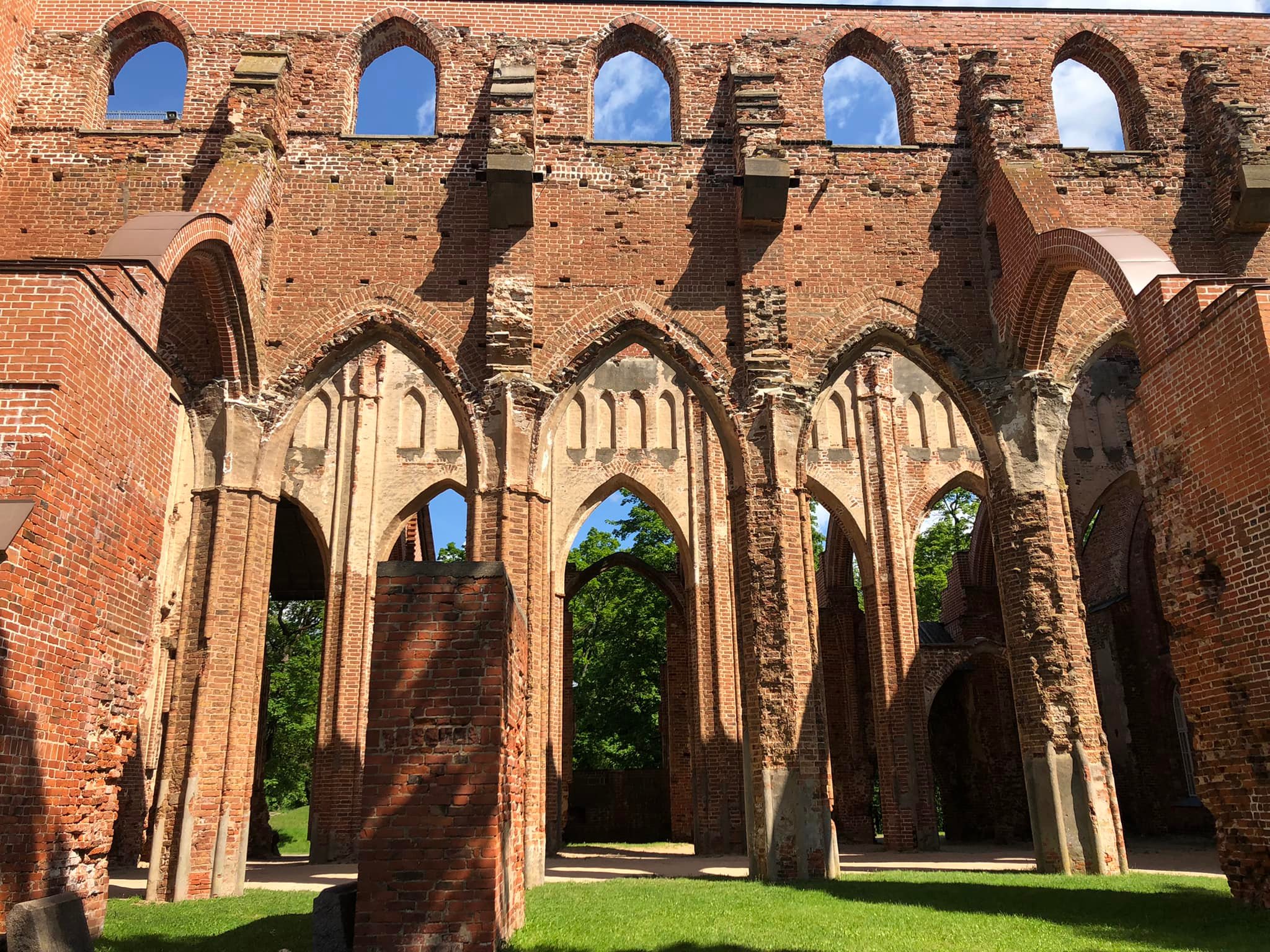
Taru was our last Estonia destination. In planning the trip, I wanted to visit because it is not only the second largest city in Estonia, but also the intellectual center, with Tartu University being located here. In retrospect, it might have been more reasonable to choose a national park or a place of natural beauty, but this ruin of Tartu Cathedral, located on the beautiful Toome Hill on the Tartu University campus, is well worth seeing. It is huge and the only mediaeval church with two spires in Estonia. The construction of the church started in the 13th century and the church was fully completed in the beginning of the 16th century.
Devastated during the Livonia War (1558 - 1583), it was left in a state of ruin and in the 1760s, the high twin towers of the church were demolished. As part of the reconstruction of the University of Tartu in 1804-1807, rooms of the university library were built in the cathedral choir. After the completion of the new university library building in 1981, the University of Tartu Museum moved in. The ruins of the Tartu Cathedral are one of the most prominent examples of brick-Gothic buildings in Old Livonia. Really lovely.

Sunday, July 17, 2022

Central Market, Tallinn, Estonia

There are several things that we love to do when we travel that we do pretty much every time we go to a new place, and one of those is visit the market. First, we need to have a little bit of food on hand, and a regular supermarket is a good way to not only pick up some food but also to see what is on offer. On our first day in Tallinn, unenergetic and sleep deprived as we were, we managed to go into a little neighborhood market, kind of like a 7-11 sized place, but the fragrant smell of ripe fruit greeted us when we opened the door, and we got some cheese, fruit, and charcuterie that was both delicious and reasonably priced. A very good sign for the quality of food in Estonia!
We love to go to big central markets, with lots of vendors and food on display, and Tallinn has an excellent one. It is located in a very uncharming neighborhood just south of Vanlinn (old town) and it did not disappoint. In particular, the fish and seafood are amazing to behold. The roe that we had almost everyday was so delicious, and just look at the woman scooping it out of big bins into slightly smaller ones! It is plentiful as well!

Friday, July 15, 2022

Kalamaja, Tallinn, Estonia

We stayed in the Kalamaja neighborhood in Tallinn. I really loved the location, an easy walk to the old city, but easy to drive around, a neighborhood grocery store where we bought some cheese, fruit, and charcuterie that smelled like a farmer's market, the fruit was so ready to eat, and a lot of bus stops for using local transport to get to further flung places.
It is a wooden architecture district situated between the fortified Old Town and the sea. It is one of the oldest suburbs of Tallinn and a hundred years ago was populated mostly by fishermen, harbor workers, and craftsmen. When Tallinn was connected to Saint Petersburg by rail in 1870 and the nearby central railway station (Baltic Station) was built, the area changed immensely. The industrial revolution and factories needed workers, so extensive apartment buildings were erected in the end of the 19th century. Much of the housing stock was built between 1890 and 1940, mostly apartment buildings in timber and brick.
During the Soviet occupation, Kalamaja was seen as a somewhat run-down, undesirable address – the communist utopia favoured large apartment blocks in the new districts, such as Mustamäe, instead – but during the last decade, the area became ultra-trendy and is now locally known as “hipsterville” of Tallinn. I am sure I would find this a real pain to maintain, but I find it absolutely charming to behold. Here are a few examples!

Wednesday, July 13, 2022

Kadriorg Palace, Tallinn, Estonia

Kadriorg Palace, or “Catherine's Valley,” was commissioned by Peter the Great of Russia for his second wife, Catherine I, and while less opulent than their St. Petersburg digs, there is a strong resemblance to them. Surrounded by acres of wooded parkland with an ornamental lake, formal gardens, and several museums, the complex sits on the edge of Kesklinn district of Tallinn. The palace, designed by famed Italian architect Nicola Michetti, is an exquisite example of Petrine Baroque architecture, which flourished in St. Petersburg in the 17th and 18th centuries. As it seems that a trip to Russia is not going to be possible in the short run, this will give a sense of the oppulence and wealth that Peter the Great commanded.
The art that is housed here pales in comparison to the building itself. The Great Hall at Kadriorg is pristine white, with light streaming in through its many windows and an exuberance of stucco ornamentation. Stylized monograms of Peter and Catherine are crafted on opposite walls above the highly ornate fireplaces. The ceiling has a beautiful mural, depicting a scene from Ovid’s Metamorphoses. The goddess Diana is seen bathing in a celestial spring along with her nymphs, while an enraptured Actaeon watches, as yet unnoticed. Peter died before the palace was complete, and the Baltics became less popular once the Russians had captured Crimea, and there was a Black Sea option open to Russians. Sound familiar?

Monday, July 11, 2022

Kuma Museum, Tallinn, Estonia

The aim of the Kumu Art Museum, opened in 2006, is to preserve and interpret Estonian art from the 18th century to the present day. It is a stunning building, and accessible on public transportation, and should not be missed. There is no place else to quickly immerse yourself in the the history of Estonian art. There is an interesting introductory film (in English with Estonian subtitles) that describes the diaspora of Estonians post-WWII and the influences both within Estonia and from abroad. Kumu views its role as being an initiator of a social and cultural debate in connection with both expositions of art history and events in the Gallery of Contemporary Art, which is the funkiest floor of the museaum.
There is an interesting interplay in the works on display between oppression and freedom. It is helpful to do a quick run through of Estonian history and keep the time line in mind when viewing the art and when it was made. Besides preservation, important tasks of the museum include displaying the works of art in its collections to initiate debates on their meaning and to shape various interpretative environments. In the fifteen years before Kumu was opened, people did not have constant access to the classics of Estonian art and the permanent display of Soviet art only became possible once Kumu opened. The expositions speak to different audiences: to the well-versed and the relatively unknowing, the old and the young, local and foreign visitors, schoolchildren and to their teachers, art lovers and art experts.

Saturday, July 9, 2022

Lore Bistro, Tallinn, Estonia

This is another bib gourmande restaurant in Tallinn, and the location couldn't be nicer, right on the pier. The interior has warehouse height ceilings, big and airy, and if the weather is nice you can eat on the patio. I was a bit leary of that option, but was happily surprised that the food came out at the appropriate temperature, and it was overall quite enjoyable. The down side is that the service was just so so.
The chef, Janno Lepik, was awarded the Michelin Young Chef award, which highlights those up and coming chefs with outstanding food preparation quality. We tried a variety of things on the menu, mostly coming out of the water rather than from the land--the trout pictured is one such example--and all of it was well prepared and delicious.

Thursday, July 7, 2022

Estonian Maritime Museum, Tallinn, Estonia

There are two sites for this museum, which chronicals the history of the relationship that Estonia has with the sea. The avowed mission of the Estonian Maritime Museum is to be the institution for collecting, preserving, studying and presenting Estonian maritime culture and history, and to promote knowledge about, respect for and love of the sea. I really liked this site, which has both models of boats going back to the time of the Hanseatic League, and one actual relic. The Museum was founded in Tallinn on the initiative of former captains and sailors in 1935. During its long history, the museum has moved on a number of occasions and since 1981, its main exhibition is located in the 500-year-old Fat Margaret tower in Tallinn Old Town. Don't miss the roof terrace, which offers food and drinks as well as a splendid view of the passenger harbour, the city centre and rooftops of the Old Town.
The Seaplane Harbour, including the Seaplane Hangar, was built to become part of Peter the Great’s naval fortress 100 years ago on orders from the Russian emperor Nicholas II. The architecture of the Hangar is remarkable, featuring the world’s first columnless thin-shell concrete domes of such volume. The building was used for seaplanes until the Second World War It is a hanger-sized museum where you can walk around the floor on on a catwalk abovce looking down. It accommodates the Lembit submarine, built in 1937 by the British Vickers–Armstrongs shipyard; a Short 184 seaplane; the Maasilinn ship (i.e. the oldest sunken ship discovered in Estonia’s waters); and numerous other genuine items, like sail ships, boats and naval mines.
There are also an exhibit about the German invasion of Estonia in August of 1941, which was an unmitigated disaster on a far larger scale than Dunkirk. The Soviets held Estonia as part of their secret pact with the Germans until then, and were forced into a hasty evacuation of Tallinn. They did succeed in evacuating 165 ships, 28,000 passengers and 66,000 tons of equipment, but at least 12,400 are thought to have drowned in circumstances little known outside the former Soviet Union. The event was long downplayed by the Stalinist regime after the war and as with many things we experienced in the Batic countries, there is an effort to expose Russian atrocities that occurred there. The evacuation wasn the bloodiest naval disaster of the war.

Tuesday, July 5, 2022

Siuru Literary Movement, Tallinn, Estonia

Siuru, named after a fire-bird in Finnic mythology, started here, in this bookstore in Vanlinn, or Old Town Tallinn. It was a literary group of the utmost importance in Estonia’s cultural context, founded in May 1917. It was the second-to-last year of World War I, bringing pivotal events that included the abdication of Tsar Nicholas II and Estonia achieving extensive autonomy from the Russian Empire: a hint of freedom was in the air. Political exiles of the 1905 Russian Revolution were allowed to return home. According to the plaque outside, it was a neoiromantic and expressionist movement that also had an affinity for futurism and impressionism. In a country that had been jockeyed about since before the times of the Hanseatic League, Siuru philosophy stressed the freedom of the human spirit. The group had mottoes that included Carpe Diem! and May The Joy Of Creation Be Our Only Moving Force! Its symbol was the white chrysanthemum. A major result of the group's activities was popularizing literature among the Estonian population, which led to the development of original Estonian literature in the youg republic. The movement was short-lived, but the members rose to be major figures in 20th century Estonian literature. Those who write tell the story. This period of freedom between the World Wars was a template for independence when the Soviet Union crumbled in the late 20th centry.

Sunday, July 3, 2022

KGB Museum, Tallinn, Estonia

The KGB were everywhere in occupied countries in the post WWII Soviet Union, and Estonia was no exception. The Baltrics were pawns in a chess game that Germany played with Russia, trying to appease them with territory they had lost in the wake of the Russian Revolution so they wouldn't come to the aid of Europe, at least not to begin with. On August 23, 1939 Nazi Germany and the Soviet Union surprised the world by signing the German-Soviet Nonaggression Pact, in which the two countries agreed to take no military action against each other for the next 10 years. The pact also contained a secret agreement in which the Soviets and Germans agreed how they would divide up Eastern Europe, divvying up countries between them in a very aggressive way. The museum of this underground prison from the Soviet times tells this story as well as the story of Estonians who fought against the Soviet invasion, both during and after the war.
On August 23, 1989, several months before the Berlin wall came down, and on the 50th anniversary of the pact that destroyed Baltic independence, two million people joined hands from Tallinn to Riga to Vilnius, spanning 675 kilometers, each nation singing their own national songs. The event was organised by the Baltic pro-independence movements: Rahvarinne of Estonia, the Tautas front of Latvia, and Sąjūdis of Lithuania. The protest was designed to draw global attention by demonstrating a popular desire for independence and showcasing solidarity among the three nations.

Saturday, July 2, 2022

Mantel and Korsten, Tallinn, Estonia

The Michelin Guide comes to Estonia! I am not sure, in the light of the fact that the Nordic White Guide, that it is a huge boon, but it has been a guide for us in the past. We have very much enjoyed the bob gourmande restaurants, which are excellent cooking at a good value--who can argue with that? Even though we had a car, we had just arrived in Tallinn the day before we ate here, and we were happier negotiating on foot and mass transportation. Having traveled before there was an affordable data plan and google maps to navigate public transport, we were very grateful to be able to do so without too too much trouble (a little trouble is all). This restaurant is in a house in a neighborhood, but near to Kadriorg Park and the museums therein. The restaurant is Italian, with a nice wine list and a short menu that changes. The pictured dish was my favorite of the evening--a monk fish that actually tasted a bit like shellfish, and the tomato raviolis, which had a bit of soup within each one, such a pleasure to bite into. I would happily eat here again, and would recommend it if you are visiting.

Thursday, June 30, 2022

Great Guild Hall, Tallinn, Estonia

The Great Guild Hall was one of the most distinguished public buildings of medieval Tallinn and with a 21st century restoration under its belt, it is still quite distinguished today. The Gothic-style building, completed in 1410, was built on what was then the main street, and near the Town Hall. It was commissioned by the Great Guild, the association of Hanseatic merchants. Over the centuries a variety of events have been held in the Great Guild Hall, ranging from grand parties and weddings to church services and court proceedings. In the Middle Ages the cellar was used for storing wine, and in the 19th and 20th centuries the popular wine cellar known as Das Süsse Loch ("Sweet Hole") operated there. During the 19th century the building, then known as the Stock Exchange, was used not only for business but also as a lively arts venue. The Great Guild Hall has housed the Estonian History Museum since 1952. We went in because it is on the Tallinn card and therefore free once you have paid a flat fee. There are a number of exhibits on view, but this wall of video exhibits telling the history of Estonia, a horrific history of invasion and domination byt foreign powers, with some brief interludes of independence, is enchantingly told in a number of different ways, and so well worth the half hour it takes to watch them through a time or two.

Tuesday, June 28, 2022

Restaurant Rataskaevu 16, Tallinn, Estonia

There are many things that reliably go right when we are on vacation, but an area that we often fall short on is the meal on the first night. Not so in Tallinn. We managed to find a small neighborhood grocery store and buy a few things to snack on within a few blocks from our apartment, and then we went to this restaurant, which was one of a handful that were recommended by the apartment managers. It was a wonderful introduction to the trip, and a very enjoyable meal.
In addition to trying a local beer, a local spirit, and a digestif made by an aging actress who performed in a theater down the street in her heyday, we had two things that are hallmarks of the cuisine of the region--a brown bread filled with seeds, and a fish soup. These dishes were delicious, traditional, and at the same time updated and fresh. The western European and Scandanavian sensibility is very appealing, and this was the end of a great first day.