Showing posts with label Classic Novel. Show all posts
Tuesday, September 9, 2025
Persuation (2022)
Ok, there are so many interpretations of this book specifically and Jane Austen in general that it is hard to know which I like best--the Regency steeped ones or the modern versions. This one is kind of a mash up of the two. Set in the original times period, but with decidedly modern asides.
This is a thoroughly charming portrayal of Anne Elliot.She drinks red wine straight from the bottle, is seen crying in the tub and lying around in bed, narrating her romantic woes with a familiar, self-effacing wit. She also repeatedly breaks the fourth wall with an amusingly dry aside or a well-timed eye roll. Anne jokes that she’s “thriving,” and clearly she is anything but, but she’s so winning in her state of loss that we can’t help but root for her. Her plight is that the love of her life, Frederick Wentworth, was penniless when they first met, about to set sail on a Navy ship, and Ann's up tight, society obsessed family convinced her that she should give him up--which she did and eight years later she regrets that choice every single day.
Then, as luck would have it, they meet up again, and now he is a rich man, all while her own family's fortune is waning--but does she tell him how she feels? Does he tell her he carries a torch for her? No, of course not, so we all have to watch them miss each other time and time again. Not terribly satisfying, but Ann is great and so in the end, I recommend this.
Labels:
Classic Novel,
Movie Review,
Romantic Comedy
Sunday, October 20, 2024
The Three Musketeers by Andre Dumas (1844)
This is my second Alexandre Dumas book (The Count of Monte Christo was my first) and I would characterize this as a dramatized historical fiction, meaning that the era and the background events are historically accurate, including some historical characters, whereas the three musketeers and their manservants are exaggerated, larger than life characters, fiercely loyal, and improbable in their foibles but larger-than-life in their talents as marksmen and soldiers.
The setting is France, 1625. A young poor nobleman named d'Artagnan leaves his Gascony home to head to Paris. There he meets Treville, the leader of the musketeers, and manages to schedule three consecutive duels with Aramis, Athos, and Porthos--the three musketeers. The rest of the story follows our young hero while he duels, falls in love, manages to save the Queen of France, and spoil Cardinal Richelieu's plans all while achieving his dream. People die, people lie, and women do not come off well, but it is a well written adventure that is fast paced and satisfying. It was written in the era of serialized release of novels, and while lengthy, it marches forward at a good pace.
Wednesday, April 19, 2023
Madame Bovary by Gustave Flaubert (1856)
Flaubert is credited with changing the course of fiction forever and this book is the one cited as an example of his ability to summon up the mundane aspects of everyday life and render them entertaining and believable. He labored over every sentence, often writing only a page a day, but making it as close to perfect as possible. The consummate editor. This quote from him I cannot argue with (nor can I emulate): “A good sentence in prose should be like a good line in poetry, unchangeable.”
Tolstoy created Anna Karenina in the image of Emma Bovary--they are both tragic heroines, to be sure, but where we root for Anna against all odds, we watch Emma with voyeuristic distaste. Emma is of humble beginnings, and she will never escape the tyranny of her desires, never avoid the anguish that her romantic exploits leave her with, never claim the life she sought. Emma is a covetous, small-minded woman who we do not care for, and would not voluntarily take up a conversation with at a party. It is her propensity to consistently make the wrong choice that keeps us reading, like watching a disaster unfold, slowly and surely. Her husband adores her, but she is not capable of loving him, and maybe not anyone. She is fatally self-absorbed, insensible to the suffering of others, and she can’t see beyond the romantic stereotypes she serves. She is eternally looking for what she expects will be happiness, and that is the cautionary tale here. She looks for love in all the wrong places.
Thursday, August 25, 2022
The Count of Monte Christo by Alexandre Dumas
This is an action adventure revenge novel, written in 1844 by the prolific and incomparable Alexandre Dumas. The book creates a fantastic whirl-wind of unforgettable characters and interweaving story-lines that found me a bit dazzled, and also yearning for more, an even deeper glimpse into this world of treachery, romance, adventure, and mystery. It is deceptively witty and maybe a bit too much of the over-flowing charisma, but suffice it to say that there is every reason why it is on so many peoples Best Novels list.
The novel starts out with a scenic over-look of an Italian waterway in Marseilles as it carries along a lofty ship named Pharaon with one passenger in particular who is unlike any other named Edmond Dantès. A dashing young and honest man with great potential who has just returned with news that will change the course of his life, and the lives of many others, forever. He is falsely accused of traitorous activity and is sentenced to life on a prison located on an island off the coasts of Marseilles forcing him to leave behind his family, his friends, and the love of his life Mercédès. This marvelous tale unfolds within the walls of this prison and among its outer-walls as Dantès attempts to make a dashing escape with a kind mannered Abbe, who teaches him quite a bit about life and leaves him a fortune when he dies.
The rest of the novel follows not only the life of Edmond Dantès, but also the lives of his lover, best friend, family, and even his partners from his shipping company. Filled to the brim with treacherous plots, revenge, heartache, mystery, and pirating; it also contains young love, faith that knows no bounds, and families filled with the knowledge that blood truly is thicker than water.
Monday, June 6, 2022
Cousin Bette by Honoré de Balzac
This is the seventh book that I have finished in my year of reading classic 19th century French literatire, and my fifth Balzac novel--it is also written at the end of his short but ever so productive life, and a culmination of the level of contempt he has for the rich--men are ruled by their sexuality (and are also easily fooled) and women want to have thier money.
This was written in 1846 and is set in mid-19th century Paris, so comtemporaneous to its publication. It tells the story of an unmarried middle-aged woman, cousin Bette, who plots the destruction of her extended family. Bette works with Valérie Marneffe, an unhappily married young lady, to seduce and torment a series of men. The first of these is Baron Hector Hulot, husband to Bette's cousin Adeline. He sacrifices his family's fortune and good name to please Valérie, who leaves him for a tradesman named Crevel. The goings on are hard to keep up with, who is sleeping with whom and why, but in the end most come out okay or persih, largely based on the lack of predictablity in who is in charge, the Royaltists or those who support Nalopeon, and fortunes sway back and forth. The book is part of the Scènes de la vie parisienne section of Balzac's novel sequence La Comédie humaine.
Saturday, May 21, 2022
The Red and the Black by Stendahl
Yet another classic 19th century French novel!
Young Julien Sorel, the son of a carpenter who is inspired by stories of Napoleon told to him by a retired army surgeon and taught Latin by a local curate, enjoys a meteoric rise in life, only to be followed by an even more rapid fall.
Julien first becomes tutor to the mayor's children in a small town in the Alps. He has to negotiate the social and political rivalries of the status-obsessed mayor, his grasping commercial rivals, and various other dignitaries — while engaging in a love affair with the mayor's wife, Madame de Renal. Escaping from there as he careens towards being found out, Julien he stepping stones from another village on to Paris, where he becomes confidential secretary to a nobleman and has to learn yet another set of social conventions as he integrates himself into the household and its circle of aristocratic hangers-on. He enters into an affair with his patron's daughter, Mathilde, which he expedites by pretending to love another woman.
Julien's story provides a base from which Stendhal satirizes French society, from small town bourgeoisie to clerics and feckless aristocrats, and probes the psychology of love and honor.
Thursday, March 31, 2022
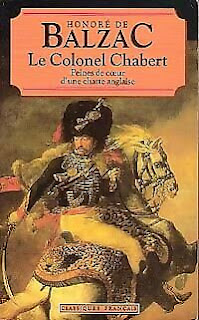
Colonel Chabert by Honoré de Balzac (1832)
I am pretty new to Balzac, but two things. He really nails the human condition in each and every tales he tells, and while this is very good, it is not his best. Read some of his novel length works and then, when you have nothing left and still need more, turn to the stories. This falls in between, as more of a novella, but I would have loved to see it fleshed out to a full length book.
The colonel is a legendary and long presumed to have fallen hero of Napoleon's rampaging Austrian campaign. He was declared dead after the Eylau, which was a bloody, deadly, and indecisive battle between Napoleon's Grande Armée and the Imperial Russian Army under the command of Levin August von Bennigsen near the town of Preussisch Eylau in East Prussia. He literally clawed his way out of a grave and is now a shattered, diminished, and yet still recognizable figure who returns to Paris to discover the breadth and depth of his wife's betrayal.
Wednesday, January 12, 2022
The Brothers Karamazov by Fyodor Dostoevsky
I read this with a group of people who were all in a group on Facebook led by the inimitable Anna Barker, a Russian Literature professor and an all round enthusiastic teacher. We read it over 100 days, whoch is about 7-8 pages a day, which sounds extremely reasonable as a pace to read at, but this book is slow. I mean molasses slow. The hardest part about this is that I read the book initially as a teenager, and I loved it. I am now somewhat afraid to reread previously loved books because my older self has a totally different view. I was so much older then, I am younger than that now. There was so much I did not know, which made the book simpler and more compelling. Now it is a twisted mess.
The themes of spiritual malaise, Faustian bargains, and philosophical paradigms are ever present. What you see is not exactly what you get, as so much is hidden somewhere between the lines as his characters showcase different beliefs and ethics, leaving us to pick up the pieces. The storytelling is tense and replete with drawn out buildups, that are usually redeemed by deeply poignant payoffs. The plentiful and fairly diverse cast of characters act as case studies of societal ills that remain today, and we are left to grapple with them. Dostoevsky leaves us sad and reconciled to our human state.
Subscribe to:
Posts (Atom)