Search This Blog

Showing posts with label National Parks. Show all posts

Wednesday, January 31, 2024

Española-Island, Galapagos, Ecuador

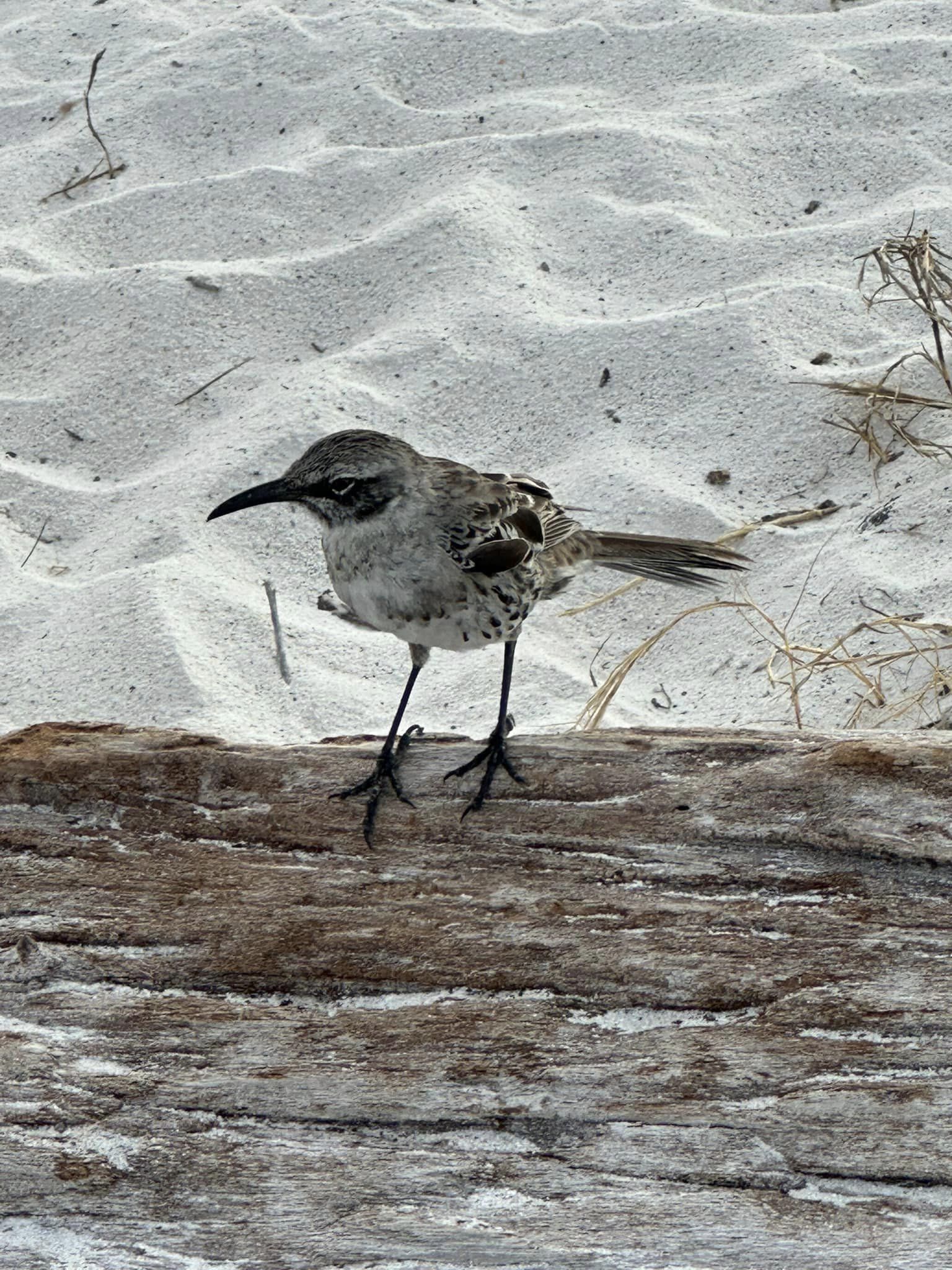
Española is the southernmost of the Galapagos Islands and is also one of the oldest. Geologists estimate it is about four million years old. Española is a classic shield volcano, created from a single caldera in the center of the island. Over thousands of years, the island slowly moved away from the Galapagos hot spot where it was formed and the volcano became extinct. Erosion began to occur, eventually resulting in one of the flattest islands in the archipelago with one of the lowest elevations. Because Española is one of the most isolated islands in Galapagos, it has a large number of endemic species — the Española mockingbird, the Española lava lizard, and the waved albatross, to name a few. The mockingbird is quite charming, having a very long bill that it uses to bust into things to eat, very little need to fly so it mostly hops from place to place, and a very charming nature—one came and ate flies, which were ubiquitous, right off our legs in a gentle and adorable manner.
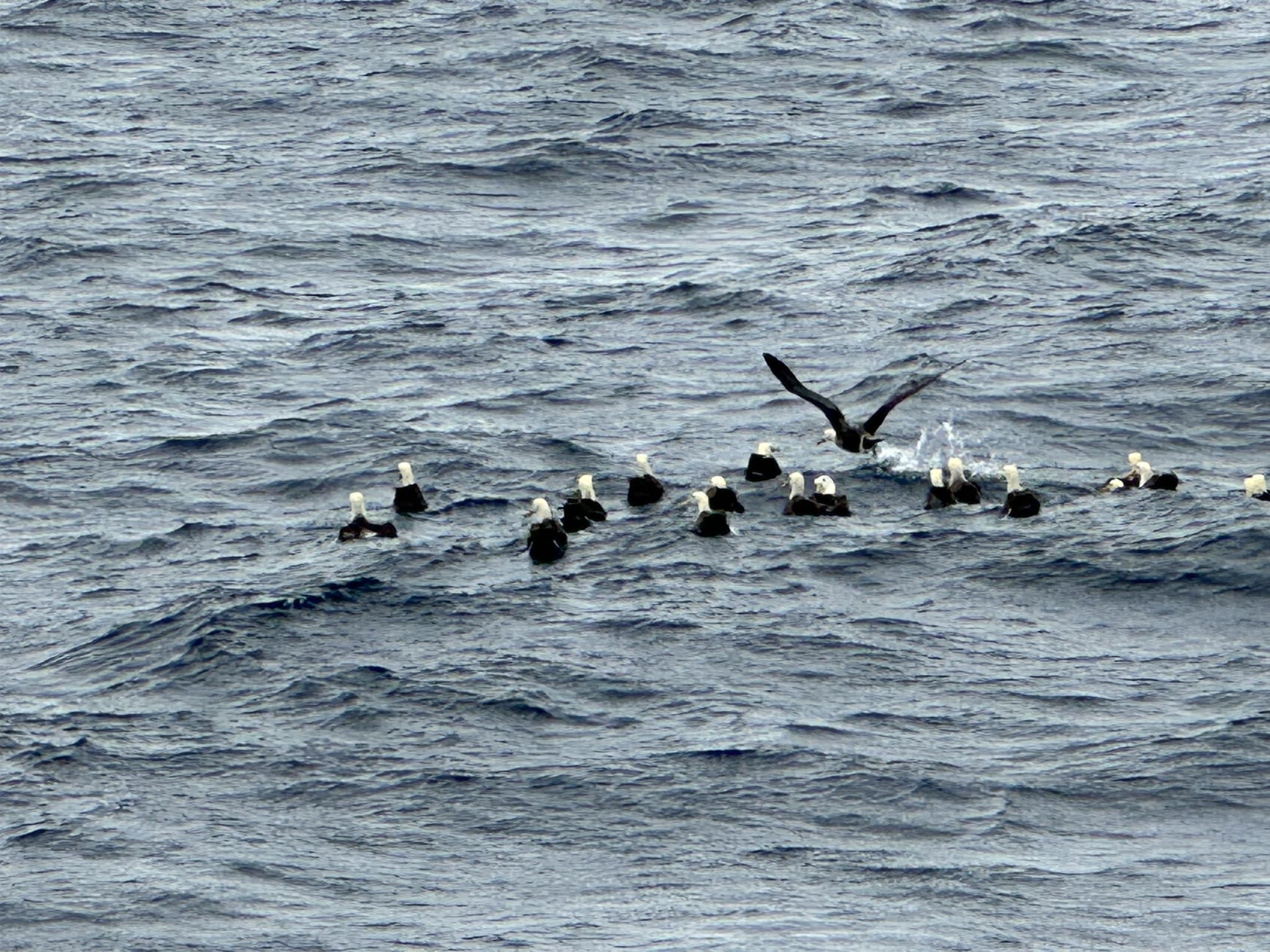
Waved Albatrosses are the largest birds in Galapagos. They are remarkable birds, standing nearly 1 m high with wingspans of 2 to 2.5 m and living up to 40 years. Every year the entire world’s population of adult Waved Albatrosses returns to Española during the nesting season, from April to December. The nesting site is the only one in the world, and it was closed to visiting due to bird flu being reported on several islands.

Saturday, January 27, 2024

Santa Cruz, Galapagos, Ecuador

Los Gemelos (the twin craters) Long ago when Santa Cruz island was an active volcano, lava flowed freely from the highlands summit down to the coast. Lava tunnels (or tubes) and magma chambers form when the top level of lava is slow moving and solidifies, while the lava below continues to flow. The result is a hollow chamber or tube, covered over by a thin layer of solidified lava. In the case of Los Gemelos, the fragile lava surface caved in due to erosion or tectonic shifts. When the chamber roof collapsed it revealed these huge sink holes. An impressive eight of the thirteen Darwin Finch species can be spotted here. The differences between finches is quite subtle; look for differences in color, beak size, body size and behavior to correctly identify them. We mostly did not go to that level.
Bellavista Lava Tunnel. This is the largest lava tube I have ever been in. As you descend into the tunnels via stairs, you quickly lose sight of the sun and enter the darkness. Even though they have lights hung throughout. you still have limited visibility. My spouse spotted two barn owls in the gloom, but mostly it is just a very cool place to hike through.

Tuesday, January 23, 2024

Darwin Center, Santa Cruz, Galapagos Ecuador

The Charles Darwin Research Center was created in 1960 by an international committee in order to promote research, conservation, and education in the Galapagos Islands.erIn In addition to the exhibition center, the tortoise rearing house and the adult tortoise house, provide opportunities for visitors to observe the 11 subspecies of tortoises up close. In the rearing house, hatchlings and young tortoises are nurtured until they can be released, at about four years of age, to their home islands. Nearly 2000 young tortoises have been released so far.
Tortoises that cannot be released back into the wild find their home in the adult tortoise house, an area with several different enclosures for the education and protection of tortoises from each subspecies. Handling the tortoises is prohibited, but this is a great place to get close up photos of the tortoises feeding on cacti and snoozing by the artificial pond.

Friday, January 19, 2024

Giant Tortoises, Santa Cruz, Galapagos, Ecuador

Santa Cruz is the second-largest island in Galapagos and it hosts the second largest population of the second-largest dome-shaped giant tortoise. Giant tortoises have traditionally been known to forage on the western slopes of the island, which is typically wetter and more densely vegetated. Humans followed a similar pattern when they settled in Santa Cruz, choosing the tortoises’ natural areas to do farming and cattle ranching. The Galapagos National Park, however, came in not long after and set aside 97% of the land surface and established it as a protected area, leaving 3% for settlers to carry on with their lives and daily activities.
But tortoises ignored this human decree and continued migrating annually to the wet highlands in order to feed on grass – right there on the very properties that were set aside for the colonists! So, on Santa Cruz Island, if you want to see giant tortoises, you must visit a cattle ranch! Tortoises like it better there, especially during this time of year. In the end, cattle ranchers lost their territorial battle yet realized tortoises brought no harm to their economy, in fact, they actually improved it.

Monday, January 15, 2024

Post Office, Floreana, Galápagos, Ecuador

Floreana is the site of the first “post office”, established in 1793, and it was a pit stop for 18th-century whalers traversing the oceans. After months, or even years, on the job, the homesick seamen came up with an ingenious system of getting letters to their families. They erected a barrel on Floreana Island and left their mail for sailors on passing ships to deliver. The first mention of the post office appears in the Journal of a Cruise, Captain David Porter’s account of his 1813 trip to the Galápagos, according to a timeline crafted by John Woram, author of Charles Darwin Slept Here. In his book, Porter recalls a crew member returning with papers “taken from a box which he found nailed to a pot, over which was a black sign, on which was painted Hathaway’s Postoffice.”
Twenty-five years later, another explorer documented the practice of bottling notes and leaving them to be taken back to America by fishing vessels. Those same fishermen “would never fail, before their departure, to touch at this island to take on a supply of tortoises.” The consumption of giant sea tortoises during this period is one of the reasons why Charles Darwin found none left on Floreana Island when he arrived in 1835. One of our postcards, the only one addressed to us, was delivered about 2 weeks after we got home, in our mailbox, no stamp!
Thursday, January 11, 2024

Floreana Island, Galapagos, Ecuador

Floreana was the first island to be colonized by Ecuadorians in 1832. It was a penal colony that didn’t last long because of the lack of fresh water. A fish canning plant was established there by Norwegian immigrants in 1924; it lasted only a couple of years. A few years later, Friedrich Ritter, a German doctor, arrived with his female companion Dore Strauch, who suffered from multiple sclerosis. A doctor of holistic medicine, Ritter removed all of his teeth and took with him stainless-steel dentures to avoid any dental complications. Together, they set up a very successful garden and lived off the land.
A pregnant Margret Wittmer arrived in 1932, with her husband Heinz and her step-son Harry. They built a house and also established an agricultural lifestyle before giving birth to their son Rolf, the first person to be born in Galapagos. He established the Tip Top fleet of yachts to bring tours to the islands, and we were on one of those boats. Floreana is most well-known for being the site of several mysterious disappearances in the 1930s—the one receiving the most attention being that of a supposed Austrian baroness, who had arrived shortly after the Wittmers with her three servants, and was quite imperious in her treatment of any and all. So more a question of who murdered her rather than why it happened. A finger was pointed at the Wittmers, but she denies any part in it in her book, published in 1962, and there was no one alive to refure her story. Coincidence? Probably. Several copies of her book Floreana were on the boat we were on, and for others, it is available on Hoopla.

Sunday, January 7, 2024

Urbina Bay, Isabela Island, Galápagos, Ecuador

Giant tortoises! The giant tortoise is an iconic species from the Galápagos and is only found on these islands. They are the largest living tortoise in the world. It used to be four islands. On June 24, 2012, the world-famous giant tortoise affectionately known as “Lonesome George” passed away. He was the last surviving land tortoise from Pinta Island, one of the northern islands in the Galápagos. Thought to be 100 years old, Lonesome George lived at the Charles Darwin Research Station since he was found in 1971. For more than three decades, the Galápagos National Park tried to save the Pinta subspecies by finding George a mate. Unfortunately they did not succeed. Sadly with Lonesome George’s passing, there will be no more Pinta Island tortoises.
Urbina Bay is one of the youngest features in the Galápagos. It was mainly formed in 1954, when a sudden uplift of the land raised the seabed by over 5 metres, and pushed the coastline over 1 km further away. This has resulted in the astonishing site of heads of coral stranded far from the water. Exposed to the air and elements, the coral heads are rapidly deteriorating and are one of the sights of the Galápagos that won't be around for much longer.

Wednesday, January 3, 2024

Tagus Cove and Elizabeth Bay, Isabela Island, Galapagos, Ecuador

Tagus Cove is located on the Northwestern coast of Isabela. It is a historical site visited by Charles Darwin in 1835, where graffiti has been carved into the rock walls by visitors over the past centuries; this happened just before the Galapagos National Park was established in 1959-1960. This cove was a hideout for whalers and pirates, as it is protected by the surf and is also a perfect place to anchor. The name of the site dates back to 1814 when it was visited by a British ship, The Tagus, which had anchored there in search of giant tortoises to be used as food supply on the boat.
he Galapagos penguin is one of the smallest penguins in the world and is endemic to the Galapagos Islands. It is the most northerly occurring penguin species, nesting entirely in the tropics, with some colonies living on the northern tip of Isabela north of the equator. They are closely related to the African, Humboldt and Magellanic penguins, all of which are burrow-dwelling. As there is no soft peat in which to burrow on the Galapagos Islands, Galapagos penguins instead live in caves and crevices in the coastal lava. They, like all penguins, are adorable to watch and you can occasionally swim along side them.
Here we have the full view of the flightless cormorant! It is not only the heaviest cormorant species, but also the only one out of 29 species which cannot fly. They are therefore confined to the lava shoreline and beaches of Isabela and Fernandina. They have stunted wings that are one third the size of the wingspan they would require to fly.

Saturday, December 30, 2023

Fernandina Island, Galapagos, Ecuador

Fernandina is the westernmost island in the Galapagos Islands, the third largest and youngest of the islands, less than one million years old. It is the most volcanically active and sits at the center of the hot spot that created the Galapagos Islands. It first appeared on the navigational charts and crude map produced by the British buccaneer Ambrose Cowley in 1684. He named it Narborough Island in honor of Sir John Narborough, an English naval commander of the 17th century. Its Spanish name, Fernandina, was given to honor King Fernando of Spain, who sponsored the voyage of Christopher Columbus. The island is most famous for its continuing series of volcanic eruptions. Many of the early visitors to the archipelago commented on dramatic changes in the landscape, smoking craters, and actual eruptions. The most famous of these is the description of a violent eruption in 1825 by Benjamin Morrell, the captain of the New York-based schooner Tartar. Another important historical event was the discovery and collection in 1906 by Rollo Beck of the California Academy of Sciences Expedition of the only giant tortoise ever found on Fernandina.
There is a lot of shore life on this island, but the highlight is the massive groups of marine iguanas that can be found gathering on the black lava rock onshore or swimming and eating in the ocean nearby. The California Academy of Sciences houses the largest collection of specimens brought back from the Galapagos, most notably a finch collection so significant that it continues to help modern-day researchers answer scientific questions.

Tuesday, December 26, 2023

Punta Vicente Roca on Isabela Island, Galapagos, Ecuador

Isabela Island is the largest of the Galápagos Islands, with an area of 4,586 km² and a length of 100 km. By itself, it is larger than all the other islands in the chain combined and it has a little under 2000 permanent inhabitants. The island straddles the equator; we crosed it twice as we circumnavigated it.
The Galapagos flightless cormorant is an endemic species to Galapagos, and is not only the heaviest cormorant species, but also the only one out of 29 species which cannot fly. They are therefore confined to the lava shoreline and beaches of Isabela and Fernandina Islands. These were so close to our panga that you could have touched them--in fact, one nipped the bum of one of our co-passengers!
BRown noddies in Galapagos are closely related to the tern family and are the largest of all noddies, easily distinguished by its cousin the Black noddy thanks to its larger size and feathers. It resembles a pigeon of sorts, with a greyish-white cap at the top of their heads that fades into the dark brown feathers that cover the rest of their body. Their white eye-ring is a distinctive feature in adults. The brown noddy is rarely seen near the land as a result of being pelagic, flying out for extended periods in the warm tropical waters, searching for small fish and/or squid, swooping low and using how-dipping and contact-dipping to catch its prey. They nest on these shoreline cliffs.

Friday, December 22, 2023

Santiago Island, Galapagos, Ecuador

Santiago, originally named James Island after England’s King James II, was the second of the Galápagos Islands visited by Charles Darwin. The Beagle arrived there on October 5, 1835. There they found a party of Spaniards who had come from Charles Island to dry fish and salt tortoise meat. About 6 mi inland they discovered two men living in a hovel, who were employed catching tortoises. Santiago had long been a source of water, wood, and tortoises for buccaneers and whalers, as well as Captain Porter of the USS Essex from 1812-1814.
Everyone has heard of Darwin's finches, but it was the mockingbird that convinced Darwin that evolution was at work in the molding of species on our planet. Darwin's plant collections were all clearly marked and documented, as Henslow had taught him. But Darwin did not always record the exact island where he found each Galápagos bird. "It never occurred to me, that the productions of islands only a few miles apart, and placed under the same physical conditions, would be dissimilar." Too late, he realized that many organisms were unique to each island-a fact confirmed by his mockingbird specimens. Darwin sorely regretted the lost opportunity to do a systematic study of each island, writing, "It is the fate of every voyager, when he has just discovered what object in any place is more particularly worthy of his attention, to be hurried from it."

Monday, December 18, 2023

Bartolomé Island, Galápagos, Ecuador

Bartolomé Island was named after Sir Bartholomew James Sulivan, a friend of Charles Darwin who served as principal surveyor and second-lieutenant aboard the HMS Beagle. Bartolomé is a barren islet in Sullivan Bay to the east of Santiago Island. Bartolomé is home to a distinctive and recognizable site of the archipelago: Pinnacle Rock. Pinnacle Rock, a volcanic cone, was formed when magma was expelled from an underwater volcano; the sea cooled the hot lava, which then exploded, only to come together and form this huge rock made up of many thin layers of basalt. You may recognize Pinnacle Rock from the 2003 movie “Master and Commander.”
The Galapagos Penguins, the second smallest penguin species in the world, have established a small breeding colony in a cave behind Pinnacle Rock. In 1982, these creatures suffered a massive decline during El Niño when the overall population in Galapagos declined from nearly 15,000 to fewer than 500 birds and they have been slow to recover. The most recent cause of concern came in July 2008 when a Plasmodium parasite species was found in Galapagos Penguins. Researchers are worried that this parasite could potentially lead to avian malaria.
This lava is so uncomfortable. Pahoehoe lava is a type of basaltic lava that is smooth and thicker (higher viscosity) than aa lava. In Hawaiian, pahoehoe means smooth, unbroken lava. It creates interesting shapes and natural sculptures across the landscape. As it flows a skin or crust forms on the top layer which then gives way allowing another flow – which forms a skin, and so on.

Thursday, December 14, 2023

North Seymour Island, Galápagos, Ecuador

Named after the English nobleman Lord Hugh Seymour, North Seymour was formed by a series of uplifts of submarine lava along with Baltra (also called South Seymour) and the northeastern part of Santa Cruz, resulting in flat plateaus. In the early 1930s, members of the Hancock Expeditions moved approximately 70 land iguanas from Baltra Island to North Seymour in order to provide better conditions for their survival, as introduced goats were destroying the habitat on Baltra and contributing to their declining population. Land iguanas are not native to North Seymour Island.
The trail on North Seymour includes a loop that goes along the coast then veers inland, providing visitors with ample opportunity to observe the largest colony of magnificent frigatebirds in Galápagos, blue-footed boobies, and land iguanas, shore birds, as well as sea lions and marine iguanas along the coast.
So many babies!! We were never again so close to nestsm and so many of them. It is very close to the airport, and a wonderful first day introduction to the islands.

Friday, December 1, 2023

The Beak of the Finch by Jonathan Weiner

This book won the Pulitzer Prize the year that it was published, which was almost 30 years ago. It is a book about two biologists, Peter and Rosemary Grant, who were studying rapid changes in the birds on the Galápagos Islands, where Darwin observed the same creatures in the 1830s. The Grants, along with their investigative team, spent decades capturing ground finches on Daphne Major, banding them, taking measurements and blood samples, and then observing their mating (amongst several other features). They were able to see adaptive change happen almost literally before their eyes, putting what Darwin hypothesized happened into very specific time, place, and reason as to why finches change, flourish, and flounder over the course of years, not millennia. Throughout the book, Weiner jumps effortlessly from Darwin’s world to that of the Grants. He is able to juxtapose the two experiences both in Galapagos and back at their respective homes perfectly, highlighting both their methods of research in various, yet specific, ways. This is a great peak at evolution in action, even if you are not about to go to the Galapagos to see it for yourself.

Wednesday, November 29, 2023

Galapagos: A Natural History Guide by Pierre Constant

This is the third book that I have read in preparation for a trip to the island archipelago, and here is what I thought. The geology of the islands, which is purportedly the thing that interested Darwin most about them, is detailed in both understandable writing as well as pictures (there are photographs as well as simple line drawings that spell it all out quite clearly. I skipped Earth Sciences in high school and never doubled back to study it at all, so if I can understand it, pretty much anyone can follow it). The other thing that stands out in the comprehensive cataloging of the flora and fauna is the extensive photographs, which help a visual person manage the large amount of data in your head. The background on why these things are significant is scanter than in other volumes on the same subject, but overall, it adds to what I have already read, and I would recommend it, especially to certain kinds of learners and those with specific interests in the Galapagos.

Tuesday, November 28, 2023

Evolution's Workshop by Edward Larson

This book is thoughtfully conceived and expertly written and serves as a good companion for travelers to the Galápagos islands and students of the history of science alike--which applies to me right now! Having read several books about the isolated islands, this one highlights best the well known authors who have visited and written about the Galápagos. European explorers who came across the islands in the 16th century had a less exalted view of the rugged volcanic archipelago, noting on their maps and in their logs that they had seen a bit of hell on earth; even as late as the 19th century, Herman Melville would call the islands “evilly enchanted ground.” Those who landed on the islands, as Charles Darwin would do on the voyage of HMS Beagle, encountered odd, novel species that turned the notion of the great chain of being on its head. Some scientists preferred to ignore the giant tortoises and candle-like cacti of the place, which did not neatly fit into the prevailing natural history of the time. Others, like Darwin, were intrigued by the evolutionary patterns that emerged, whereby species exhibited perceptible differences from island to island, suggesting that geographical separation had some influence on the course of nature. Darwin’s findings, and those of the generations of scientists who followed him, would undermine special-creationist accounts of how life came to be. Their arguments changed the face of science—and also of the islands, which gave up hundreds of thousands of specimens of birds, reptiles, and plants to collectors from museums all over the world. Amazing that there is anything left to see today, but there is. This is an absorbing study of the role of the South American island chain in shaping evolutionary theory.

Monday, November 27, 2023

Galapagos: World's End by William Beebe

I have been reading books about the Galapagos in preparation for an upcoming trip there. Since this will be a one and done trip, I want to immerse myself in all things Galapagos, and this book, which is available on Google books as well as through my library's subscription to Hoopla, is one of the first hand accounts of a Galapagos expedition, as opposed to an author writing about somebody else's trip. As is widely known, in the 1830's Charles Darwin circumnavigated the globe and enroute he observed variations among the Galapagos Islands' species that inspired him to formulate the theory of natural selection. Eighty-eight years later, in 1923, a scientific expedition sponsored by the New York Zoological Society followed in Darwin's footsteps, led by William Beebe and while he is the author of this book, several of the expedition members author chapters or sections of chapters. The prose is about what you would expect from people who are primarily naturalists, meaning overly descriptive and at times quite tedious to read. That said, at the time of it's release it was wildly popular (which gives you an idea of what one had to settle for a century ago in terms of entertainment) and therefore worth giving a read if only for the immersion experience.

Wednesday, November 22, 2023

Galapagos: The Islands That Changed The World by Paul Stewart

I am going to the Galapagos! As such, I am reading all things (well, not exactly all things, but many things) that have been written over the years about the islands and the wildlife that exists there. While this is not a "must read", especially if you are interested in the science of it all, but it is a very good book to read if you want a short, not too scientific, but not a gloss over of the science of what was found there by Darwin, and why it mattered so much that he both found it and made sense of it. It is a photograph-rich volume, and if you want more than a fold out overview of the life in the water, on the land, and in the air, this is an easy way to give it all a once over, along with a brief description of the geology of the islands, and how that contributed to their uniqueness. It is definitely not scintillating reading, but it is also the best quick and straight forward overview that I have read so far.

Wednesday, November 2, 2022

New Orleans Jazz National Historical Park

I have been to la Jean La Fitte National Park that is outside of New Orleans, where we took a very memorable swamp walk with Ranger Turnipseed many years ago, and I have walked by the branch that was in or near the open air market in the French quarter, but I had never been to the Jazz Historical Park. Shortly after the French founded New Orleans in 1718, engineers drew up a formal city plan for Nouvelle Orleans---the area that we now call the French Quarter. The city quickly expanded beyond those original boundaries to become an important American port. People arrived from all over the world, joining the early inhabitants of the area to create a distinct culture rich in food, music, and tradition.
This park is dedicated to the living part of the music and culture. When we were there it was in September and so they were celebrating Hispanic History Month, and so the daily musical and dance performances celebrated traditional music and jazz from Latin America. We saw a Haitian Jazz trio with an exceptional key boardist and a traditional dance and guitar performance from Mexico. All free, and the daily schedule is on the park's website as well as the what's going on in New Orleans calandar. Music and history on a budget!

Wednesday, September 7, 2022

The Road To Hana

The sites that are associated with the road to Hana actually extend beyond the town of Hana all the way to the southern entrance of Haleakalā National Park. There are a lot of dire recommendations that you should then turn around and do the whole thing in reverse rather than risk being stuck on the back road home, and that you should maybe just give up all together and go on a tour. If you have a driver who loves to drive, I highly recommend you do the whole road and you do it on your own. It is a long day and having to wait for people on these tours can be even harder, and you can customize where you stop and where you go. So here goes. The Hana Highway (HI-360) has 620 curves and 59 bridges. Each and every bridge is one way, and so the recommendation is that you start early so there isn't too much traffic, but at each bridge it might be an opportunity for the driver to see things too! And if there isn't traffic (the day we did it I would say it was pretty light, so it can happen, even in the summer), you can go slow and maybe even pause on the bridge to relish the view. The road leads you through flourishing rainforests, flowing waterfalls, plunging pools and dramatic seascapes. There is jaw dropping beauty in an enviable variety the whole route and I can see why it is on so many people's bucket lists.