Search This Blog

Showing posts with label Latin America. Show all posts

Thursday, August 27, 2026

Tamayo Contemporary Art Museum, Mexico City, Mexico

The Tamayo Museum (Museo Tamayo) was founded by Ruffino Tamayo in 1981, when the Mexican artist donated his own works, in addition to a massive collection of international contemporary art, with the goal of showcasing 20th-century art for the public. My favorite part of the whole museum was Tamayo’s collection of his own work that he hand picked to be on exhibit in the museum. The building, designed by Mexican architects Teodoro González de León and Abraham Zabludovsky, is made of reinforced concrete and white marble stone and is located in Chapultepec Park, a vast green space in Mexico City. The low-slung design and natural tones allow the building to hide in and among the trees. Inside, glass walls and light wood floors make the gallery spaces feel contemporary, open, and spacious.
Well-curated exhibitions change throughout the year, but the focus is always on contemporary and modern art, be it painting, video installation, and mixed-media, nicely bridging the twentieth and twenty-first centuries. Occasionally, there are also interactive exhibits. There are always seasonal exhibits. The museum is basically divided in half, with its permanent collection and new, temporary shows. The space itself makes for easy transitions between the wings and the central courtyard; a few steps sunken into the ground often feature sculpture.

Sunday, August 23, 2026

Caracol De Mar, Mexico City, Mexico

This is a Michelin Bib Gourmand restaurant. We stayed in the Condesa neighborhood on our recent trip to Mexico City, and this was an easy walk from out apartment. Chef Gabriela Camara’s hospitality and vision shine the brightest at the newest iteration of the restaurant (it apparently had moved), which welcomes guests with bar seating and cocktails on the first floor and a stunning salon filled with natural light on the top floor. The downside of the space is that it has a lot of hard surfaces and is really quite loud. The culinary ethos remains, with sustainability and seasonal seafood at the core and all-time menu favorites in tow. Order the green mole risotto and the fish tacos—they were both delicious, and the side sauces are a high point.
This is recommended, especially if you want to lean into seafood, and the sound level didn’t sound like a negative. Of the two seafood restaurants we ate at, this one was more upscale and had more memorable accompaniments to the dishes.

Wednesday, August 19, 2026

Jardin Bosque de Chapultapec, Mexico City, Mexico

This is a beautiful and quite peaceful garden that is near to museums in Mexico City. We like to take some time to read outdoors when we are traveling, and this was a perfect spot to do that. It is generally believed that the Chapultepec Botanical Garden originated during the reign of Nezahualcoyotl. The Chapultepec complex was known as a natural reserve for the rulers of Tenochtitlan and the Triple Alliance. It is almost certain that some plants were cultivated here for medicinal and food purposes. This modern version was inaugurated in 2006 covering 5.3 ha reserved within the park. A magnificent landscape, today it houses a valuable collection of native and introduced plants. Since 2016, the garden has been rehabilitated and cared for by the organization Plantando con Causa A.C.. They have brought in world-class landscapers, botanists, horticulturists and biologists to meticulously restore some 22 unique environments within the garden. In 2017, the garden boasted more than 300 varieties of plants, distributed as follows: Pollination plants Edible plants Succulents Wetland plants 14 species of wild dahlias Agaves Cactaceae Orchids And an arbor There are also other plants. It is a critical part of Chapultepec’s landscape, and much like the day we were there, it is not usually crowded.

Monday, August 17, 2026

Green Rhino Bakery, Mexico City, Mexico

This bakery is world class. It comes from star baker Richard Hart, renowned for his bakery Hart Bageri, with multiple locations in Copenhagen, and is his first bakery in North America. It opened in July of this year in a new building in Roma Norte. The space is huge. A wall of glass at the front, a pastry counter, and up a ramp, a small seating area that looks over the bakery floor, expansive and busy, which includes a lamination room, a walk-in freezer, and ovens the size of a studio apartment. Workers mill about, shaping loaves and filling trays. And the line can wrap around the block. There is a rotating cast of pastries, cookies, danishes, rolls, buns, and laminated numbers, which are very, very rich (likely half of their weight is butter) and shatteringly crisp. Look for those with fresh fruit to offset the fat and the savory ‘nudja and requeson rectangle. The bread is exceptional: deeply browned loaves, speckled with pepitas, seeds, and bran, with a sour, open-crumbed interior, begging for a thick smear of salted butter. For this style of sourdough, high-hydration with a robust, chewy crust, it is simply the best in Mexico City (and priced fairly, to boot). For beverages there is coffee, tea, frappes made with coconut water, matcha, and hot chocolate. There are also merch, jams, spreads, and fancy teas, from his romantic partner, the “raretealady" Henrietta Lovell, plus his James Beard-award-winning cookbook for sale.

Sunday, August 9, 2026

Expendio de Maíz, Mexico City, Mexico

This was my favorite food experience overall. A one Michelin star place with tables on the street--and only four of them, all communal tables--we ate with some young dermatologists who trained together in the not too distant past and were in town for soccer. There is a no sign, no menu, and cash-only, sidewalk operation in Roma Norte offers a surprising experience that prioritizes food over fuss. In place of typical creature comforts, find a bustling kitchen that cooks and cooks until diners tap out. It is anyone’s guess as to what’s coming but know that heirloom corn nixtamalized and ground in house serves as the foundation for many of the dishes. Tortillas, sopes, and huaraches alike are molded and griddled to order and then dressed in a dazzling variety of seasonal ingredients and sauces. Tableside salsas pack lightning bolts of heat and enliven every course. It was phenomenal. I just wish I was hungrier.

Friday, August 7, 2026

The Gelman Collection, Museo de Arte Moderno de México, Mexico City

The Gelman Art Collection is take your breath away amazing to behold. Sometimes it is better to be lucky than good. More on this museum later, but man oh man this is worth the trip to see. Here is a bit about the reason it hasn’t been available for public viewing: For the first time in 20 years, the Gelman Collection, perhaps the best private collection of modern Mexican art, is on view at the Museo de Arte Moderno (MAM) in Mexico City. The 68 objects that make up the temporary exhibition have been locked away since the death of Natasha Gelman in 1998. In the intervening decades the collection has become the stuff of legend here in Mexico, with whispers of the murder in 2013 of the notary who witnessed Natasha’s contested will; suits and countersuits over the means by which an elderly and diminished Mrs Gelman came to leave her Riveras, Kahlos, Tamayos and Izquierdos to a relatively unknown curator in New York named Robert Littman; and the disappearance of a large group of pre-Columbian treasures from the Gelman apartment in New York, whereabouts still unknown.
We were lucky to see the Chester Dale Collection of largely Impressionist Art at the Art Institute of Chicago (Diego Rivera painted his portrait as well) years ago and this gives me the same feeling of awe. The Gelman’s lived with these treasures.

Monday, August 3, 2026

Pujol, Mexico City, Mexico

We had the taco omakase at Pujol, Chef/owner Enrique Olvera’s seminal dining room that has long stood as one of the country’s most famous addresses. This breezy, contemporary space is a constant hive of activity, thanks to the 95 elegant servers who circulate throughout the equallyelegant space. In the introduction we were asked about insects 🐜. Our neighbors said no, then, well if you can’t see them, maybe? No, he was quite clear, you can see them. We started and ended in the garden—which is brilliant from a table management focus but also it is such a pleasant spot.
A foodie friend asked:How did you enjoy? The restaurant creates a ton of buzz! I replied that we were glad we went but it a one and done for us. The food is impeccably prepared, some exceptional flavor bombs and like nothing we have had before. It is always a win when you have an experience like no other. It is next level, but next time? More taco stands, less fine dining

Thursday, July 30, 2026

Taquería El Jarocho, Mexico City, Mexico

This is a Michelin Bib Gourmand taqueria--where it is important to note that while they open at 9:30, they do not start serving off their more extensive menu until later in the morning. But you can always have tacos!
El Jarocho has eighty years of history backing it up, and has been run by three generations of the same family. It was originally a tortilleria, and they're known for their guisado-style tacos, offering a wide variety of proteins and vegetables stewed in a number of different ways. And don't skip their campechano taco with chopped steak and topped with crispy chicharron--that was Joel's favorite--mine was the mile verde tacos. Fresh tortillas are made in-house.

Sunday, July 26, 2026

Casa Azul, Frieda Kahlo Museum, Mexico City, Mexico

The Frieda Kahlo Museum is the blue house where she was born, died, and spent most of her life within these walls. It is a gorgeous space and it is filled with some of her possessions, some of her clothes and jewelry, and some of her art. A hard to beleive fact is that as many people visit this museum as do the National Museum of Anthropology, a museum that encompasses the history of Mexico. Frida’s father, Guillermo Kahlo – Hungarian-German by birth – had the house built in 1904. The historian Beatriz Scharrer, “in the style of the time: a central courtyard surrounded by all the interior rooms, and the exterior totally French.” The home was the meeting place for many of the great personalities who lived or met with Diego and Frida. Among them, Leon Trotsky, Henry Moore, Remedios Varo, and André Breton.
The kitchen has been preserved in its original condition, and remains an important part of the entire house. All the objects within it, including dinnerware and cookware, reflect the impact of Mexican culture on the artists’ daily lives. It is very beautiful in itself and it was very cool to visit. I bought tickets well in advance and if you think you want to go, so should you.

Wednesday, July 22, 2026

Contramar, Mexico City, Mexico

It was our first night in Mexico City, and even though there wasn't much of a time change from home, we had to get up early to get there, so an early dinner was in order. Thank goodness we had a reservation because the place was completely packed at 4:40 in the afternoon--perhaps aided by a World Cup game, which could be seen (and heard) from every corner of the large restaurant with closely packed seating. This is not a quiet place at the best of times, but if you like a lively festive environment and do not need to hear yourself think, this is a great place to eat seafood. My favorite dish was the shrimp tostada and the signature dish of the restaurant is the whole fish, grilled and then served half with salsa verde and half with salsa rojo. The whole meal was excellent and I would recommend it. The chef Gabriela Cámara has served as a culinary advisor to a former Mexican president, so not like we discovered this place!

Saturday, June 27, 2026

Latinísimo by Sandra Gutierrez

My on line cookbook group is cooking out of this book this month, and I am surprised by a number of things about it. The first is that I did not know this book had been published--it is a relatively comprehensive cookbook covering all 21 Latin countries in the Americas. That is both its strength and its weakness. Do you need to own it? I would say yes--I have been going to Central and South America since I was a child, and I have been an avid home cook for almost 50 years and there were many things that I learned about the region and the cuisine from reading this book. There is a lot of information about the differences in cuisine across the region, including the kinds of peppers and what you can do with them that are worth the price of admission. The downside is that while it is almost unliftable in weight, it lacks depth into any particular cuisine--that it unsurprising, but this is not the be all and end all of Latin American cooking--rather it is an excellent starting point and one that should be explored. It is available on used book sites for under $10 and well worth it.

Saturday, January 24, 2026

Next Year In Havana by Chanel Cleeton

This is one of Reese Witherspoon's Book Club choices and I am in the midst of slowly reading all of those, which is a fun endeavor. It is also the first in a series of books that look at this family across family members and over decades. The book shifts between present day and the time of the Cuban Revolution. The past focuses on Elisa, who is the daughter of a sugar plantation owner who falls in love with a revolutionary. The present is Marisol, who is her granddaughter. After the death of her beloved grandmother, she travels to Havana, where she discovers the roots of her identity–and unearths a family secret hidden since the revolution. The past is Havana, 1958. The Perez family supports Batista and is forced to leave Cuba for Miami, but hope to return one day. Elisa believes her lover has been killed, but she leaves Cuba pregnant with his son. Miami, 2017. Freelance writer Marisol Ferrera grew up hearing romantic stories of Cuba from her late grandmother Elisa, who was forced to flee with her family during the revolution. Elisa’s last wish was for Marisol to scatter her ashes in the country of her birth. Arriving in Havana, Marisol comes face-to-face with the contrast of Cuba’s tropical, timeless beauty and its perilous political climate. When more family history comes to light and Marisol finds herself attracted to a man with secrets of his own, she’ll need the lessons of her grandmother’s past to help her understand the true meaning of courage.

Sunday, July 13, 2025

The Water Museum and the History of Sanitation, Buenos Aires, Argentina

This is also known as El Palacio de las Aguas Corrients, or the Palace of Running Water, and it is spectacularly beautiful inside and out. In the mid-19th century, Buenos Aires was experiencing massive population growth and several epidemics, including cholera and yellow fever. So the city decided to fix the water supply. It took 7 years to build, finiahws in 1894, and it contains 12 water tanks (provided by a Belgian firm) with a total capacity of 72 million liters of water. The style of this building is quite eclectic and is yet another example of the upper classes of Argentina fancying everything European. Almost everything was pre-fabricated in Europe. There are over 300,000 tiles making up the exterior of the building, each individually numbered to enable easy placement. In addition to being a water and plumbing museum, it is also where you go to pay your water bill.

Wednesday, July 9, 2025

Benito Quinquela Martín Museum

Benito Quinquela Martín was a painter of ports. This arts museum in the heart of La Boca was donated to the city by the artist--he is the man responsible for the bright colours of La Boca neighbourhood. His intention was to create an educational and cultural centre in the neighbourhood. As I learned from reading a biography of the city, Buenos Aires did not have an exceptional port. The river is too shallow and it was never the thriving port of other Latin American cities--but because of the enormous wealth coming out of Potosi in the form of silver, there was money to be made and and the port thrived despite it's failings. The museum's collection is representative of the history of Argentine art and features several key figurative artists working from the late 19th century to the present day. It houses the largest collection of Quinquela Martín’s oil paintings and etchings in existence, all completed between 1922 and 1967. There’s also a unique collection of ship figureheads, and, on the terrace, a display of Argentine figurative sculptures. Temporary exhibitions are held in the Sívori room, and on the third floor, the Casa Museo Benito Quinquela Martín exhibits some of the artist's personal possessions.

Thursday, June 26, 2025

Crizia, Buenos Aires, Argentina

We had some spectacular food on a recent trip to Argentina, and this was my favorite meal. While Argentinian beef is world reknowned, it really isn't my thing, and what you might forget in all the hype about the parilla grill, the gaucho, and the grasslands is that it has hundreds of miles of coastline. This restaurant is all about things that come out of the water. Owner-chef Gabriel Oggero works with small-scale independent producers, fishermen and farmers in order to source the very best seasonal ingredients (the restaurant also has its own rooftop city garden). Oysters are a particular speciality and fish-lovers will delight in a menu which is completely focused on seafood and shellfish.
I live in a very land-locked place, so having a dozen small plates of this kind is amazing to me, and then there is the presentation--there is an emphasis on natural things, with stones and wood featuring prominently as the vehicle for each dish, and then the ceramic plates and bowls are impressively gorgeous as well. The attention to detail is special, and I would definitely return here should we be in Buenos Aires in the future. As a bonus, it was a few minute walk from our hotel, where I would also return.

Wednesday, June 18, 2025

Mishiguene Restaurate, Buenos Aires, Argentina

This was our first dinner in Argentina and it was a very good start to an excellent food trip. We arrived at opening time--8:30 at night--and were the only ones in the place. I do struggle with that in general, and combat it by having a late lunch instead of dinner, and that has been a good strategy as I age, having the heaviest, and sometimes the only, meal of the day a bit earlier, so that by the time I am settling down to sleep the meal is well on it's way in the digestive cycle. The thing about cultures that start dinner so late is that no one is going to bed before midnight and often not until the wee hours of the morning, and that is just not how we roll. Unless there is a 6 hour time difference and then it it perfect. We can essentially stay on our time, less jet lag in both directions. Argentina is both an overnight flight to get there and a minimal time difference, so let's just say I was not at my best. The food is both Ashkenazy and Sephardic cuisine that revives the flavours of traditional Jewish food from a contemporary perspective. These revive Jerusalem-trained chef Tomás Kalika’s childhood recollections and his quest for food that imprints an immigrant population on the history of a place--these are his words and high goals. One of Mishiguene’s signature dishes is Pastrón, a beef prime rib cured for ten days with salt, herbs and spices, which is then smoked over wood embers for four hours, and steam-cooked for a further fourteen--it was the only dish that did not wow us--everything else was great.

Thursday, May 15, 2025

Crizia, Buenos Aires, Argentina

On a recent trip to Buenos Aires we found it to be a city with a lot of excellent dining options. It was not an inexpensive city, and this is not a bargain, but it is a good value for visitors from Europe and the United States. We had the all seafood tasting menu, which is a favorite of mine. The seafood is sourced from all over Argentina's vast coastline, and the raw ingredients were spectacular. Equally impressive was what the chef did with them, dishes that highlighted the qulity of the seafood but also added or boosted it's natural flavor. What I think of as the add ons--the bread and the dessert--were good. The bread was spectacular, one with flavorful wheat and cultured butter and the other with flavorful corn. The desserts were very restrained, to the point where a dessert person might be disappointed, but for me it meant I didn't leave overwhelmingly full. I would 100% recommend this restaurant and would go back on a return trip.

Friday, June 14, 2024

Everyone Who Is Gone Is Here by Jonathan Blitzer

This is a sweeping, all-inclusive investigative reporter style book about Central America, immigration, and the United States. While politicians in general and the GOP especially characterize this as a problem at best and a humanitarian crisis at worst that is of Central America's making, the truth is that we are the alpha and the omega of the issue. We are the beginning because we have chronically interfered in the politics, the government, and the economics of Central America and then we are the end because much of what is driving violence in the region is drugs and those drugs are coming to the United States, and then also because we are seen as the promised land, where all will be solved, and as we know that is truly never the case. Only Fox News makes the life of the immigrant seem unduly idle and rewarded, and that is solely for the purposes of fanning the flames of fury against brown skinned people, not that they believe it to be true. The story is overly long and complex, and perhaps by necessity, so is this book. The tentacles of United States businesses in Central America is so widespread as to be hard to believe. "How did this happen" would be a reasonable question that is largely not answered and too big for the scope of the book, which is already sweeping. Unfortunately sometimes the most important message, which is that the Trump administration with the white supremacist Steven Miller at the helm, did unspeakable things to immigrant families for money, political power, and probably no small amount of sadistic pleasure, and at some point, we need to really try to fix the enormous problem that we have no small part in creating rather than pointing fingers of blame elsewhere, and have the expectation that it will only marginally improve because we have made such a mess of it.

Wednesday, January 31, 2024

Española-Island, Galapagos, Ecuador

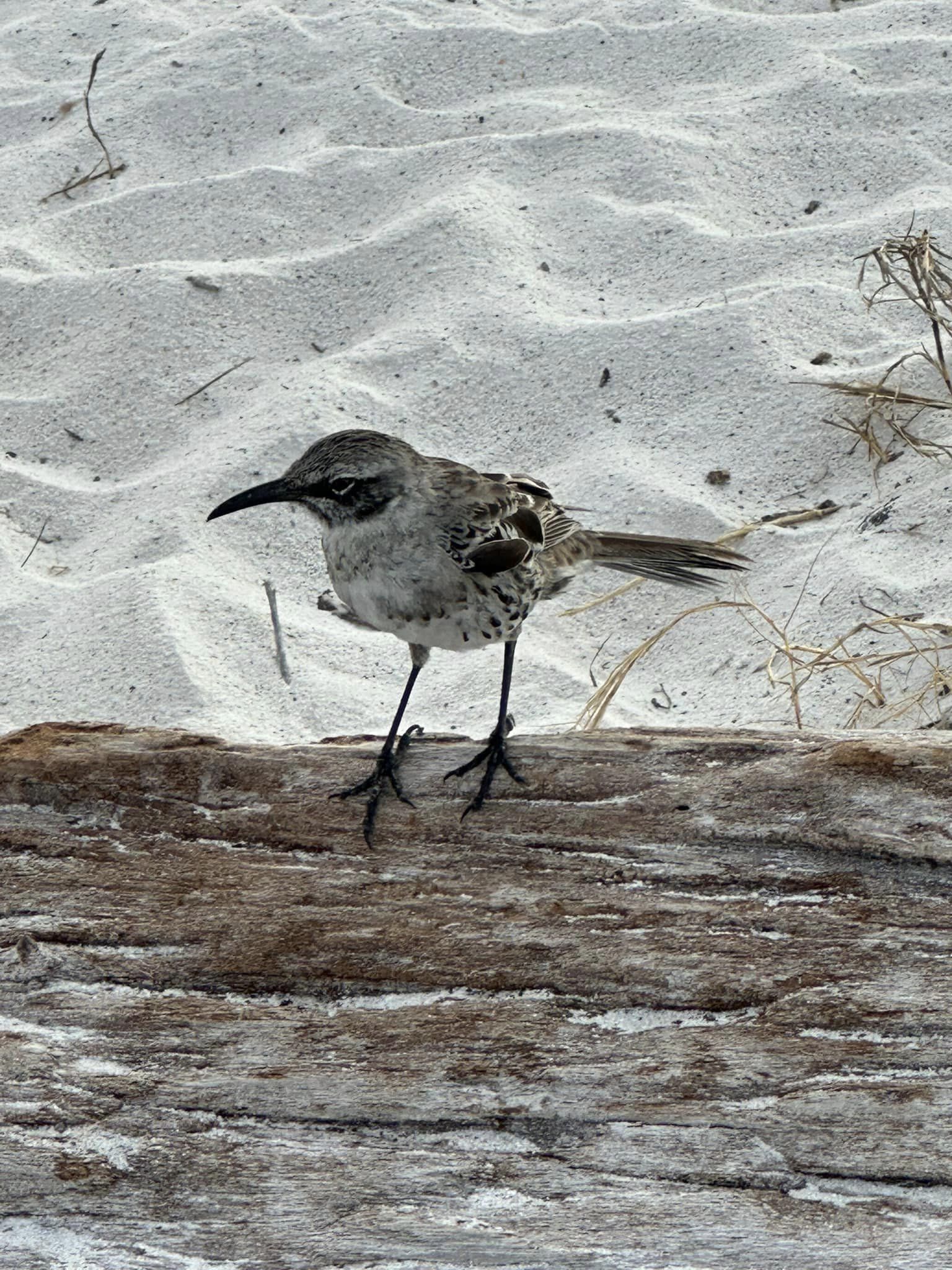
Española is the southernmost of the Galapagos Islands and is also one of the oldest. Geologists estimate it is about four million years old. Española is a classic shield volcano, created from a single caldera in the center of the island. Over thousands of years, the island slowly moved away from the Galapagos hot spot where it was formed and the volcano became extinct. Erosion began to occur, eventually resulting in one of the flattest islands in the archipelago with one of the lowest elevations. Because Española is one of the most isolated islands in Galapagos, it has a large number of endemic species — the Española mockingbird, the Española lava lizard, and the waved albatross, to name a few. The mockingbird is quite charming, having a very long bill that it uses to bust into things to eat, very little need to fly so it mostly hops from place to place, and a very charming nature—one came and ate flies, which were ubiquitous, right off our legs in a gentle and adorable manner.
Waved Albatrosses are the largest birds in Galapagos. They are remarkable birds, standing nearly 1 m high with wingspans of 2 to 2.5 m and living up to 40 years. Every year the entire world’s population of adult Waved Albatrosses returns to Española during the nesting season, from April to December. The nesting site is the only one in the world, and it was closed to visiting due to bird flu being reported on several islands.

Saturday, January 27, 2024

Santa Cruz, Galapagos, Ecuador

Los Gemelos (the twin craters) Long ago when Santa Cruz island was an active volcano, lava flowed freely from the highlands summit down to the coast. Lava tunnels (or tubes) and magma chambers form when the top level of lava is slow moving and solidifies, while the lava below continues to flow. The result is a hollow chamber or tube, covered over by a thin layer of solidified lava. In the case of Los Gemelos, the fragile lava surface caved in due to erosion or tectonic shifts. When the chamber roof collapsed it revealed these huge sink holes. An impressive eight of the thirteen Darwin Finch species can be spotted here. The differences between finches is quite subtle; look for differences in color, beak size, body size and behavior to correctly identify them. We mostly did not go to that level.
Bellavista Lava Tunnel. This is the largest lava tube I have ever been in. As you descend into the tunnels via stairs, you quickly lose sight of the sun and enter the darkness. Even though they have lights hung throughout. you still have limited visibility. My spouse spotted two barn owls in the gloom, but mostly it is just a very cool place to hike through.